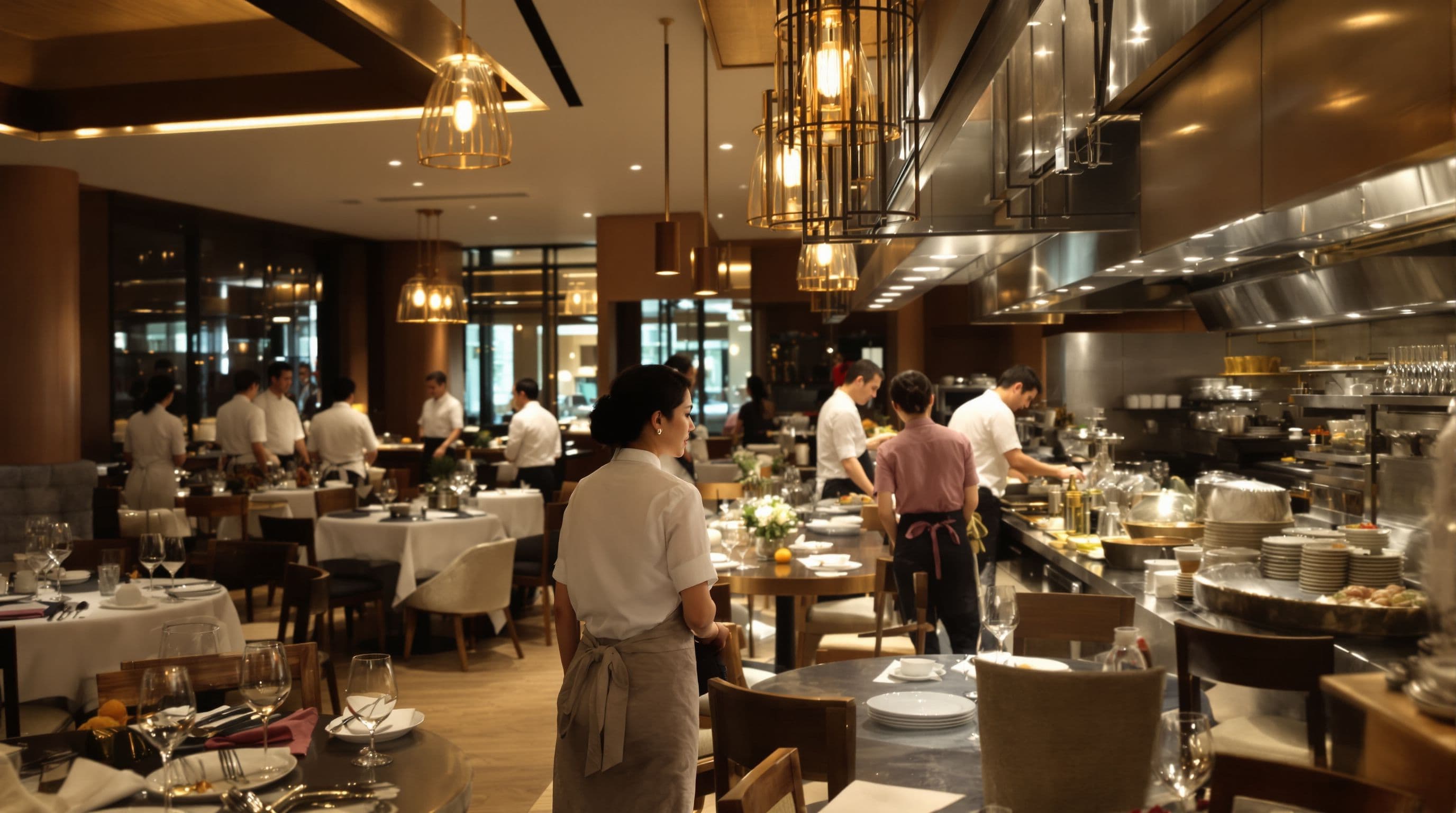
Restaurants & F&B Groups
We help multi-unit restaurant operators deploy AI across menu engineering, supply chain procurement, workforce optimization, and portfolio performance management to drive margin improvement and disciplined expansion.
CHALLENGES WE SEE
Inconsistent food quality and portion sizes across multiple locations damage brand reputation and increase customer complaints by 35-40% annually.
Manual inventory tracking across restaurant locations leads to 15-20% food waste and missed revenue opportunities from stockouts during peak hours.
Labor scheduling inefficiencies result in overstaffing during slow periods and understaffing during rushes, inflating labor costs by 12-18% unnecessarily.
Disparate point-of-sale systems across locations prevent real-time sales visibility, delaying menu optimization decisions and limiting dynamic pricing opportunities.
Customer feedback scattered across multiple review platforms and delivery apps remains unanalyzed, missing critical insights that could reduce churn rates.
Inconsistent supplier pricing and delayed invoice reconciliation across restaurant groups create cash flow issues and prevent bulk purchasing negotiations.
HOW WE CAN HELP
Know exactly where you stand.
Prove AI works for your organization.
Transform how your leadership thinks about AI in 2-3 intensive days.
Turn base AI models into domain experts that know your business.
Optimise every part of your F&B operation with AI.
Predict admissions and optimise bed allocation with AI.
PROOF
Delta Air Lines
Oscar Health

Ant Group (Alipay)
THE LANDSCAPE
Restaurant groups manage complex multi-unit operations spanning diverse dining concepts, geographic markets, and service models. These organizations face mounting pressure to maintain brand consistency, optimize supply chain efficiency, navigate labor shortages, and deliver predictable unit economics while competing against both independent operators and larger chains. Traditional centralized management struggles to balance standardization with local market responsiveness across dozens or hundreds of locations.
AI transforms restaurant group operations through demand forecasting that analyzes historical sales, weather patterns, local events, and market trends to optimize labor scheduling and inventory purchasing. Machine learning models drive dynamic menu engineering by identifying high-margin items, predicting ingredient waste, and recommending pricing strategies across different dayparts and locations. Computer vision systems monitor food quality and portion consistency, while natural language processing analyzes customer feedback across review platforms to identify operational issues before they impact brand reputation.
DEEP DIVE
Key technologies include predictive analytics platforms for multi-site inventory management, automated scheduling systems that reduce labor costs while improving service levels, and centralized business intelligence dashboards providing real-time visibility into unit-level performance metrics. Integration with existing point-of-sale, supply chain, and financial systems enables comprehensive operational optimization.
Data-driven research and reports relevant to this industry
Forrester
Forrester's analysis of AI adoption maturity across Asia Pacific markets including Singapore, Australia, India, Japan, and Southeast Asia. Examines industry-specific adoption rates, barriers to AI imp
ASEAN Secretariat
Multi-year implementation roadmap for responsible AI across ASEAN member states. Defines maturity levels for AI governance, from basic awareness to advanced implementation. Includes self-assessment to
Oliver Wyman
Analysis of AI adoption across Asian markets. Singapore, Japan, and South Korea lead adoption, but China dominates in AI talent and investment. Southeast Asia growing fastest from low base. Key findin
Intuit QuickBooks
Quarterly tracking of AI adoption and its impact on mid-market financial health. Based on anonymized data from 7M+ QuickBooks users. mid-market companies adopting AI-powered tools see 15% lower delinq
Our team has trained executives at globally-recognized brands


YOUR PATH FORWARD
Every AI transformation is different, but the journey follows a proven sequence. Start where you are. Scale when you're ready.
ASSESS · 2-3 days
Understand exactly where you stand and where the biggest opportunities are. We map your AI maturity across strategy, data, technology, and culture, then hand you a prioritized action plan.
Get your AI Maturity ScorecardChoose your path
TRAIN · 1 day minimum
Upskill your leadership and teams so AI adoption sticks. Hands-on programs tailored to your industry, with measurable proficiency gains.
Explore training programsPROVE · 30 days
Deploy a working AI solution on a real business problem and measure actual results. Low risk, high signal. The fastest way to build internal conviction.
Launch a pilotSCALE · 1-6 months
Roll out what works across the organization with governance, change management, and measurable ROI. We embed with your team so capability transfers, not just deliverables.
Design your rolloutITERATE & ACCELERATE · Ongoing
AI moves fast. Regular reassessment ensures you stay ahead, not behind. We help you iterate, optimize, and capture new opportunities as the technology landscape shifts.
Plan your next phaseAI-powered demand forecasting transforms inventory management by analyzing historical sales data, weather patterns, local events, seasonal trends, and even social media buzz to predict what each location will need with remarkable accuracy. Rather than relying on gut instinct or basic sales averages, machine learning models can tell you that your downtown location will need 30% more chicken wings this Thursday because there's a major sporting event, while your suburban units should stock up on family meal packages. This precision typically reduces food waste by 20-40% while simultaneously decreasing stockouts that cost you sales. The real power comes from centralized visibility combined with location-specific optimization. We recommend implementing systems that provide your operations team with a single dashboard showing predicted demand, current inventory levels, and automated reorder suggestions across all units. These platforms integrate with your existing POS and supplier systems to generate purchase orders automatically, adjusting for each location's unique sales patterns and storage capacity. Some restaurant groups report ROI within 3-6 months purely from waste reduction, not counting the labor savings from eliminating manual inventory counts and order planning. Beyond basic forecasting, advanced AI systems can identify waste patterns you didn't know existed—like discovering that certain menu items consistently have 15% higher waste rates at specific locations due to inconsistent prep procedures, or that your weekend brunch service systematically over-prepares eggs Benedict. These insights enable targeted training interventions and recipe adjustments that compound savings over time.
Most restaurant groups see measurable returns within 6-12 months, but the timeline varies significantly based on which AI applications you prioritize. The fastest ROI typically comes from labor optimization and demand forecasting—areas where you're making daily decisions that directly impact your largest cost centers. Groups implementing AI-driven scheduling systems often see 5-10% labor cost reductions within the first quarter as the system learns to match staffing levels precisely to predicted demand, eliminating both overstaffing during slow periods and costly understaffing during rushes. Menu optimization and dynamic pricing deliver strong returns but take slightly longer—typically 4-8 months—because you need sufficient data to identify patterns and test recommendations across different dayparts and locations. However, groups that implement these systems report 3-7% increases in contribution margin as AI identifies which menu items to promote, when to run specials, and how to price items differently across locations based on local market conditions. The compound effect is substantial: a 5% improvement in labor costs plus a 4% improvement in food costs plus a 3% revenue increase from better menu engineering can transform a marginally profitable location into a strong performer. We always advise starting with one or two high-impact use cases rather than attempting a complete transformation simultaneously. Supply chain optimization or labor scheduling are excellent entry points because they deliver quick wins that build organizational confidence and generate cash flow to fund broader initiatives. The groups that struggle most are those that try to implement everything at once, overwhelming their teams and never achieving the operational discipline needed to realize AI's benefits.
This is one of the most common concerns we hear, and it reveals a fundamental misunderstanding about how AI should work in restaurant group operations. The goal isn't to have AI create wildly different experiences at each location—it's to maintain your core brand standards while optimizing the operational variables that customers don't directly experience. Your signature dishes should look and taste identical everywhere; AI helps ensure that consistency by monitoring portion sizes through computer vision, flagging quality issues before customers notice them, and identifying locations where execution is drifting from standards. What should vary by location—and where AI adds tremendous value—are the operational decisions that happen behind the scenes. Your downtown location might need different staffing patterns than your suburban mall unit, different inventory levels, and perhaps different promotional strategies, but customers walking into either location should experience the same menu, service quality, and ambiance. AI-driven systems work within guardrails you define: core menu items remain consistent, but the system might recommend that your coastal locations feature seafood specials more prominently, or that locations near universities adjust portion sizes and pricing for their demographic. We recommend establishing clear brand standards and operational boundaries before implementing AI systems. Define which elements are non-negotiable (signature recipes, plating standards, service protocols) and which are flexible (staffing levels, inventory quantities, local marketing). The most successful restaurant groups use AI to achieve better brand consistency, not less—by identifying locations that are deviating from standards, predicting which units will face quality issues based on operational metrics, and ensuring that every location has the right ingredients and staff to deliver your brand promise.
The single biggest challenge is data fragmentation—many restaurant groups have accumulated a patchwork of POS systems, inventory management tools, scheduling software, and accounting platforms that don't communicate with each other. AI systems need clean, integrated data to function effectively, and groups often underestimate the effort required to consolidate and standardize their data infrastructure. Before implementing any AI solution, you need a clear picture of what data you're collecting, where it lives, and how it flows between systems. Groups that skip this foundational work end up with AI tools that can't access the information they need or, worse, make recommendations based on incomplete or inaccurate data. The second major pitfall is treating AI as a replacement for operational discipline rather than an amplifier of it. If your locations aren't consistently following basic procedures—accurate inventory counts, proper recipe execution, timely data entry—AI will simply automate chaos. We've seen groups invest heavily in sophisticated forecasting systems only to discover that managers ignore the recommendations because they don't trust the underlying data. Successful implementation requires change management: training your team to understand what the AI is doing and why, establishing accountability for following system recommendations, and creating feedback loops so the system improves over time. Finally, many groups struggle with scope creep and vendor proliferation. They implement different AI point solutions for scheduling, inventory, menu engineering, and customer analytics, creating a new form of fragmentation. We recommend starting with platforms that integrate multiple capabilities or at minimum ensure that any AI tools you adopt have robust APIs and can share data seamlessly. The goal is to build a connected ecosystem where insights from your forecasting system inform your scheduling decisions, which inform your inventory planning, creating a virtuous cycle of optimization rather than a collection of disconnected tools.
For groups in this size range, I recommend starting with a focused pilot program at 3-5 representative locations rather than attempting a full rollout. Choose units that span different profiles—a high-volume flagship, a struggling location that needs improvement, and average-performing units—so you can demonstrate AI's value across different scenarios. Begin with labor optimization or demand forecasting because these deliver quick, measurable ROI and build organizational confidence. Establish clear success metrics before you start: specific targets for labor cost reduction, waste reduction, or revenue improvement that you'll measure against control locations not using the AI system. Before launching even a pilot, conduct a thorough data audit. Work with your IT team or a consultant to map out what data you're collecting, assess its quality, and identify gaps. You might discover that some locations aren't capturing data consistently, that your POS system isn't recording information you need, or that data is trapped in systems that don't integrate. Address these issues during the pilot phase rather than after you've rolled out to all locations. Many groups find that the data cleanup and integration work required for AI implementation delivers value independently by giving them visibility into operations they never had before. Finally, invest in change management from day one. Assign an executive sponsor who will champion the initiative, identify operational leaders at pilot locations who are genuinely enthusiastic about the project, and create clear communication channels for feedback and questions. Your managers need to understand that AI is a tool to make their jobs easier and their units more successful, not a corporate surveillance system looking for reasons to criticize them. The groups that succeed with AI are those that treat implementation as an organizational transformation, not just a technology project—they redesign workflows, train teams thoroughly, and celebrate early wins to build momentum for broader adoption.
Let's discuss how we can help you achieve your AI transformation goals.
