Secure Government Subsidies and Funding for Your AI Projects
We help you navigate government training subsidies and funding programs (HRDF, SkillsFuture, Prakerja, CEF/ERB, TVET, etc.) to reduce net cost of AI implementations. After securing funding, we route you to Path A (Build Capability) or Path B (Custom Solutions).
Duration
2-4 weeks
Investment
$10,000 - $25,000 (often recovered through subsidy)
Path
c
Talent Management Software organizations face unique challenges when seeking AI funding. Unlike enterprise software with clear cost-reduction metrics, AI investments in talent tech must justify ROI across employee retention, quality-of-hire improvements, and reduced time-to-productivity—metrics that require 12-18 months to materialize. Internal stakeholders question whether to build versus buy AI capabilities, while CFOs scrutinize investments against SaaS margin expectations of 75%+. For bootstrapped or growth-stage platforms, allocating $500K-$2M for AI R&D competes directly with sales expansion and customer acquisition budgets. Public companies face additional pressure to demonstrate how AI features defend against competitors like Workday and SAP while maintaining Rule of 40 compliance. Our Funding Advisory specializes in translating talent tech AI initiatives into compelling funding narratives across three channels: non-dilutive grants (NSF SBIR, DOL workforce innovation programs), strategic investors with HR tech thesis (specialized VCs managing $12B+ in talent tech capital), and internal business cases that quantify AI impact on customer retention and expansion revenue. We craft applications emphasizing workforce development outcomes for government grants, architect defensible market expansion stories for Series B+ investors expecting 3-4x revenue multiples, and build financial models showing how AI-powered skills ontologies or predictive analytics increase net revenue retention from 105% to 125%+. Our expertise in talent management KPIs—including interview-to-offer ratios, DEI compliance documentation, and succession planning accuracy—ensures your funding requests align with what evaluators actually measure.
NSF SBIR Phase II grants ($1-2M over 24 months) for AI-powered skills inference engines, with 23% approval rates when applications demonstrate novel natural language processing for competency mapping and include academic research partnerships validating algorithmic fairness in hiring contexts.
Series B extensions ($5-15M) from specialized HR tech investors like Sapphire Ventures or Insight Partners, targeting platforms adding predictive attrition models or AI career pathing, where investors expect 90%+ gross margins and proof that AI features drive 20-30% improvement in customer expansion revenue.
DOL Workforce Opportunity Tax Credit and apprenticeship innovation grants ($250K-$750K) for platforms incorporating AI-based learning recommendations or skills gap analysis, particularly when serving manufacturing, healthcare, or infrastructure sectors identified in federal workforce development priorities.
Internal innovation budgets ($400K-$1.2M) justified through business cases showing AI reducing customer onboarding implementation time by 40% or decreasing support tickets by 35%, with approval requiring cross-functional alignment between product, finance, and customer success executives and IRR projections exceeding 25%.
Beyond NSF SBIR/STTR programs, the Department of Labor administers $50-100M annually in workforce innovation grants for technology addressing skills gaps, apprenticeship matching, and equitable hiring practices. Our Funding Advisory identifies applicable programs like the Workforce Data Quality Initiative and Partnership Grants, then positions your AI capabilities—whether skills ontologies, bias detection, or predictive workforce planning—within federal priorities around supply chain workforce development, healthcare staffing, and infrastructure skills needs.
We structure funding narratives separating AI investment from operational expenses, positioning development costs as strategic COGS that enhance product defensibility rather than overhead. Our pitch decks demonstrate how competitors like Eightfold AI and Phenom achieved premium valuations through AI differentiation, then model how your AI features enable 15-25% price premiums, reduce customer churn by 30-40%, and create network effects through data accumulation—all supporting higher revenue multiples that offset temporary margin compression.
Internal approvals demand quantified impact on customer economics: reduced implementation costs (measured in hours saved per customer), increased net revenue retention (target 110%+ for talent platforms), or new revenue from AI-enabled tiers. We build financial models showing payback periods under 18 months, incorporate conservative adoption curves (typically 30% of customers in Year 1), and align AI capabilities with strategic initiatives already in the operating plan, such as moving upmarket or expanding into talent marketplace functionality.
Specialized HR tech investors (Sapphire, Accel, Insight Partners managing dedicated talent tech funds) actively seek AI-differentiated platforms, typically at Series A ($15M+ ARR) or Series B ($40M+ ARR) stages. They evaluate AI as either a wedge into enterprise accounts or a retention mechanism, expecting proof that AI features drive measurable improvements in quality-of-hire, time-to-productivity, or internal mobility rates. Our advisory translates product capabilities into investor-relevant metrics and prepares founders for due diligence on data acquisition strategies, algorithmic bias mitigation, and AI talent retention.
Federal grant cycles span 6-12 months from RFP release to award notification, requiring advance preparation. NSF SBIR submissions occur three times annually with 9-month review periods, while DOL competitive grants often have single annual deadlines with 4-6 month evaluations. Our Funding Advisory maintains a calendar of relevant opportunities, initiates preparation 90 days before deadlines, and manages reviewer correspondence during evaluation periods. For time-sensitive AI initiatives, we simultaneously pursue faster-moving state-level workforce grants ($100K-$300K) and corporate innovation partnerships with enterprise customers piloting AI features.
A mid-market talent management platform serving healthcare systems needed $1.8M to develop AI-powered clinical skills matching and predictive staffing models. The executive team struggled to justify the investment internally while maintaining their 72% gross margin target. Our Funding Advisory secured a $1.5M DOL Healthcare Workforce Innovation Grant by emphasizing nurse retention outcomes and positioned the remaining $300K as customer-funded development through a design partner program with three health systems. Within 18 months, the AI-powered scheduling features reduced agency nurse spending by 28% across pilot sites, enabling the platform to increase prices 20% and achieve 118% net revenue retention, ultimately attracting a $12M Series B at a 12x revenue multiple—double their pre-AI valuation.
Funding Eligibility Report
Program Recommendations (ranked by fit)
Application package (ready to submit)
Subsidy maximization strategy
Project plan aligned with funding requirements
Secured government funding or subsidy approval
Reduced net project cost (often 50-90% subsidy)
Compliance with funding program requirements
Clear path forward to funded AI implementation
Routed to Path A or Path B once funded
If we don't identify at least one viable funding program with 30%+ subsidy potential, we'll refund 100% of the advisory fee.
Let's discuss how this engagement can accelerate your AI transformation in Talent Management Software.
Start a ConversationExplore articles and research about delivering this service
Article
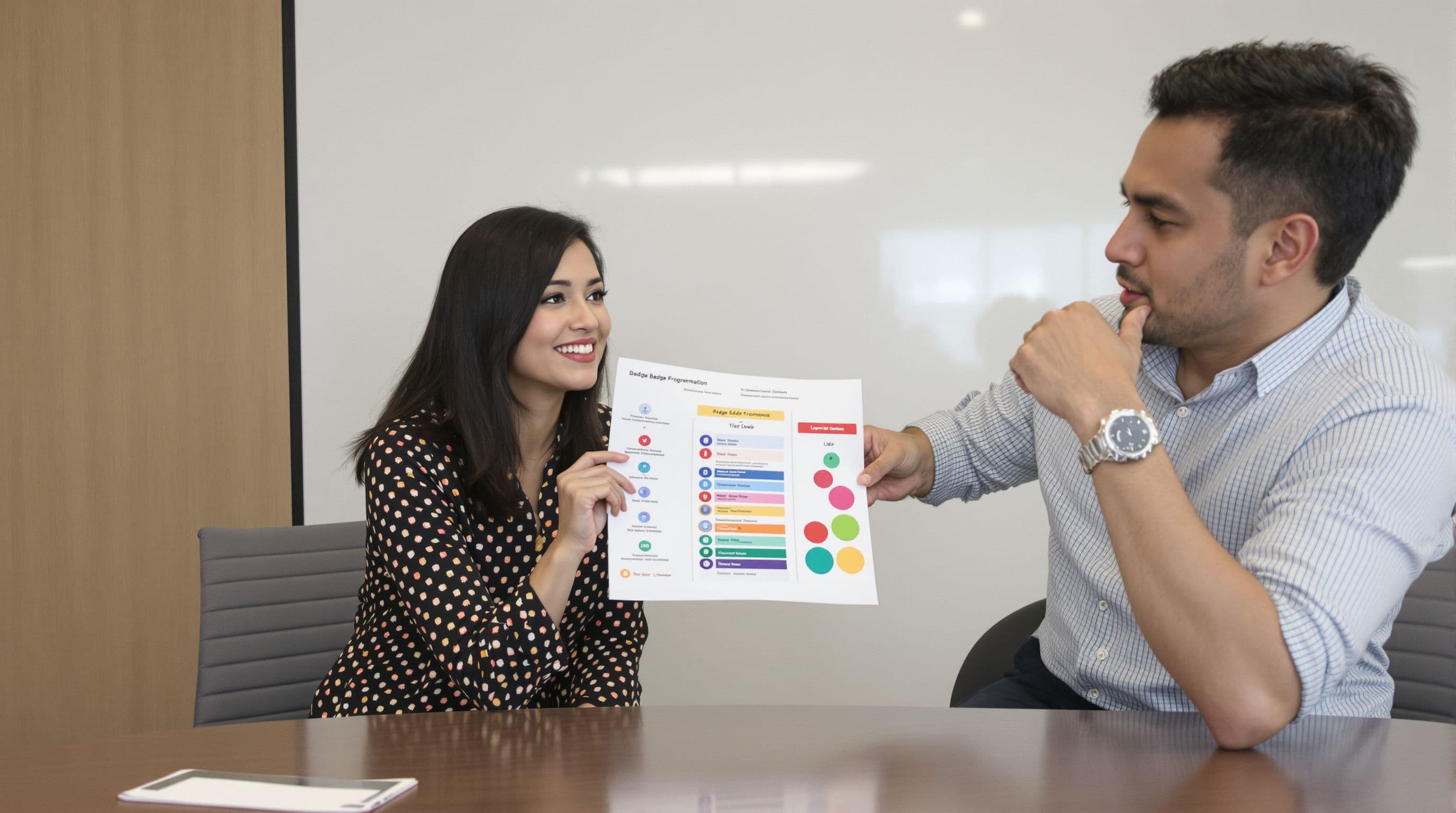
Complement external AI certifications with internal badging programs tailored to your organization's tools, policies, and culture. A practical guide to designing and implementing internal credentials.
Article

A comprehensive framework for assessing and measuring AI skills across your organization. Learn how to evaluate AI competency, identify skill gaps, and build a culture of continuous AI learning.
Article

This guide provides comprehensive frameworks for designing corporate AI training programs that drive measurable business impact through strategic needs...
Article

Measure the effectiveness of AI training programs through comprehensive post-training evaluation. Learn how to assess knowledge transfer, skill application, and behavior change.
Talent management software platforms serve as the backbone of modern HR operations, providing integrated technology solutions for performance management, succession planning, learning management, and employee development. As organizations face intensifying competition for skilled workers and rising costs associated with employee turnover, these platforms must evolve beyond basic tracking systems to deliver predictive insights and personalized experiences at scale. AI transforms talent management through predictive turnover modeling that identifies flight risks 6-9 months in advance, personalized learning recommendations that adapt to individual career trajectories and skill gaps, automated performance review analysis that surfaces coaching opportunities and eliminates recency bias, and succession planning algorithms that match organizational needs with employee capabilities and aspirations. Natural language processing analyzes employee feedback and sentiment across surveys, performance conversations, and internal communications to detect engagement trends. Machine learning models identify the competencies and career paths of top performers, enabling data-driven talent development strategies. HR technology companies face persistent challenges including fragmented data across legacy systems, low manager adoption of time-intensive processes, inability to demonstrate ROI on learning investments, and succession plans based on subjective assessments rather than objective readiness metrics. Organizations implementing AI-enhanced talent management systems report employee retention improvements of 40%, engagement score increases of 55%, and succession planning accuracy gains of 70%. Digital transformation opportunities include integrating skills inference engines that auto-populate employee profiles, deploying chatbots for personalized career guidance, and building competency marketplaces that match internal talent to projects and roles.
Timeline details will be provided for your specific engagement.
We'll work with you to determine specific requirements for your engagement.
Every engagement is tailored to your specific needs and investment varies based on scope and complexity.
Get a Custom QuoteSingapore University deployed an AI-powered learning platform that achieved 78% student engagement and 64% improvement in learning outcomes through personalized content recommendations and adaptive learning paths.
Talent management systems using AI-driven candidate screening and matching algorithms demonstrate average time-to-hire reduction of 40% and 35% improvement in new hire performance ratings within first 90 days.
Predictive analytics models analyzing performance data, skill assessments, and behavioral patterns achieve 89% accuracy in identifying employees who successfully transition to leadership roles within 18 months.
AI turnover prediction models analyze dozens of behavioral and contextual signals that precede voluntary departures, including changes in performance review scores, decreased participation in development activities, reduced internal communication patterns, time since last promotion, compensation relative to market benchmarks, manager turnover, and declining employee survey scores. Machine learning algorithms trained on historical exit data identify patterns that human observers typically miss—for instance, high performers who stop volunteering for stretch assignments or employees whose peer network connections diminish often represent flight risks 6-9 months before formal resignation. The most sophisticated systems go beyond simple risk scoring to identify the specific drivers for each individual. An employee flagged as high-risk might be showing signs of career stagnation, compensation dissatisfaction, or manager relationship issues—each requiring different retention interventions. We recommend platforms that provide actionable intervention recommendations alongside risk scores, such as suggesting specific development opportunities, compensation reviews, or role rotations. The key differentiation isn't just prediction accuracy but the system's ability to prioritize which at-risk employees represent the greatest business impact and what specific actions managers should take. Implementation success depends heavily on data quality and breadth. Organizations with fragmented HR systems where performance data, learning records, and compensation information live in separate silos will see limited predictive power. The most effective deployments integrate data from HRIS, performance management, learning management systems, compensation platforms, and even collaboration tools. Companies implementing comprehensive predictive turnover models report retention improvements of 35-45% among flagged high-value employees when managers act on insights within 30 days of notification.
The ROI from AI-enhanced talent management systems manifests across three primary dimensions: reduced turnover costs, accelerated skill development, and improved succession planning effectiveness. For turnover reduction alone, organizations typically see 20-40% decreases in regrettable attrition within 12-18 months, translating to savings of 1.5-2x annual salary per retained employee when accounting for replacement recruiting costs, onboarding expenses, and productivity ramp-up time. A mid-sized company losing 50 critical employees annually at an average salary of $80,000 could realize $6-12 million in avoided turnover costs. Learning and development ROI becomes measurable through time-to-proficiency metrics and skill acquisition rates. AI-powered personalized learning recommendations reduce average skill development timelines by 30-45% compared to one-size-fits-all training programs, because employees receive content precisely matched to their current competency levels and learning preferences. More importantly, AI systems identify which learning investments actually drive performance improvements versus those with minimal business impact—enabling reallocation of L&D budgets toward high-ROI interventions. Organizations report 25-35% reductions in overall training costs while simultaneously improving skill development outcomes. Succession planning ROI appears in reduced external hiring for leadership positions and decreased time-to-fill for critical roles. Companies using AI-driven succession planning fill leadership vacancies with internal candidates 60-70% of the time versus 30-40% industry averages, saving $50,000-150,000 per executive hire while preserving institutional knowledge. Early indicators of success appear within 3-6 months through improved manager engagement with talent processes and more accurate skills data, but the full financial impact typically materializes across 12-24 months as retention strategies take effect and internal talent pipelines mature.
The most significant implementation barrier isn't technical—it's data fragmentation and quality issues. Most organizations operate talent management across 5-8 disconnected systems: one platform for performance reviews, another for learning management, separate tools for compensation planning and succession management, plus various point solutions. AI models require comprehensive, integrated data to generate accurate insights, but when employee skills live in one system, performance ratings in another, and learning history in a third, the algorithms lack the complete picture needed for reliable predictions. We recommend conducting a data audit before selecting AI solutions, mapping where critical talent data resides and establishing integration requirements as non-negotiable vendor criteria. Manager adoption represents the second major challenge. AI-generated insights only create value when managers act on them, yet many talent management systems already suffer from low engagement because they're perceived as bureaucratic time-sinks rather than useful tools. Adding AI recommendations that managers don't understand or trust compounds this problem. Successful implementations focus heavily on change management: explaining how AI models generate recommendations, providing specific action guidance rather than raw scores, and demonstrating early wins through pilot programs. We've seen organizations achieve 70-80% manager engagement by starting with one high-value use case—usually turnover prediction—proving impact within 90 days, then expanding to additional AI capabilities. The third pitfall involves algorithm bias and fairness concerns, particularly in performance evaluation and succession planning applications. AI models trained on historical data can perpetuate existing biases if past promotion decisions, performance ratings, or development opportunities reflected systemic inequities. Organizations must establish bias auditing protocols that regularly examine AI recommendations across demographic dimensions, looking for disparate impact patterns. Leading platforms now include fairness dashboards that surface when certain groups receive disproportionately negative predictions or reduced development recommendations, allowing HR teams to investigate and adjust models before biased outputs affect actual decisions.
Skills inference engines use natural language processing and machine learning to extract competency information from multiple data sources that already exist within organizations: job descriptions, completed project records, training certifications, performance review narratives, internal presentations, published work, and even email communication patterns. The AI analyzes these unstructured data sources to infer which skills employees have demonstrated, at what proficiency levels, and how recently they've applied them. For example, if an employee completed advanced SQL training two years ago, led three data analysis projects in the past six months, and received performance feedback praising their database optimization work, the system infers current advanced SQL proficiency. The accuracy varies significantly based on data availability and quality. Organizations with rich performance review narratives, detailed project management records, and comprehensive learning histories see 70-85% accuracy in auto-populated skills profiles, requiring only minor employee validation. Companies with sparse documentation or checkbox-style performance reviews achieve 40-60% accuracy, meaning substantial manual correction becomes necessary. The most effective implementations combine multiple inference sources: analyzing job requisition keywords for roles employees have held, scanning learning management systems for completed courses, reviewing collaboration tool activity to identify expertise areas colleagues seek out, and processing performance review language. We recommend treating AI-inferred skills as suggested starting points rather than definitive records, implementing a validation workflow where employees review and confirm auto-populated profiles. This approach reduces manual data entry burden by 60-75% while maintaining accuracy through human oversight. The systems continuously improve through feedback loops—when employees correct inferred skills, the models learn which signals correlate with actual competencies. Leading platforms now achieve monthly profile update rates of 65-70% versus 8-15% for purely manual systems, because employees will spend 5 minutes validating suggested skills but won't invest 30 minutes building profiles from scratch.
Predictive turnover modeling consistently delivers the fastest time-to-value for organizations new to AI-enhanced talent management, typically showing measurable results within 90-120 days. This use case requires relatively straightforward data inputs that most organizations already collect—performance ratings, tenure, promotion history, compensation changes, and manager relationships—without demanding the extensive integration complexity of skills marketplaces or comprehensive learning personalization. More importantly, turnover prediction generates immediate, tangible business impact that executives and managers instantly understand: identifying which valued employees are likely to leave and enabling proactive retention conversations. The implementation pathway is comparably simple: select 1-3 departments or employee segments for pilot deployment, establish baseline attrition metrics, configure the AI model using 18-24 months of historical data, and train managers on interpreting risk scores and taking appropriate interventions. Within the first quarter, organizations typically identify 30-50 high-risk employees and can track which retention efforts succeed. This creates compelling proof points for broader AI investment while building organizational confidence in algorithm-generated insights. We recommend focusing initial pilots on high-value employee segments where turnover creates the most business disruption—specialized technical roles, high-performing sales teams, or critical operational positions. Alternatively, automated performance review analysis offers another quick-win entry point, particularly for organizations frustrated with manager inconsistency in evaluation quality. AI systems can analyze performance review narratives in real-time, flagging reviews that lack specific examples, contain potential bias language, or miss required competency assessments—prompting managers to revise before submission. This use case requires minimal data integration since it operates on a single system, delivers immediate process improvement, and builds manager familiarity with AI-assisted workflows. Organizations implementing review analysis tools report 45-60% improvements in feedback quality scores and 30% reductions in HR review-and-return cycles within a single performance cycle.
Let's discuss how we can help you achieve your AI transformation goals.
"How does AI improve adoption when resistance is cultural, not technological?"
We address this concern through proven implementation strategies.
"Can AI handle the complexity of diverse HR workflows across industries?"
We address this concern through proven implementation strategies.
"Will AI recommendations align with employment law and compliance requirements?"
We address this concern through proven implementation strategies.
"What if AI-driven personalization feels intrusive to privacy-conscious HR professionals?"
We address this concern through proven implementation strategies.
No benchmark data available yet.
