
 ChatGPT
 Google AI
 Claude
 Perplexity
 Grok
Grok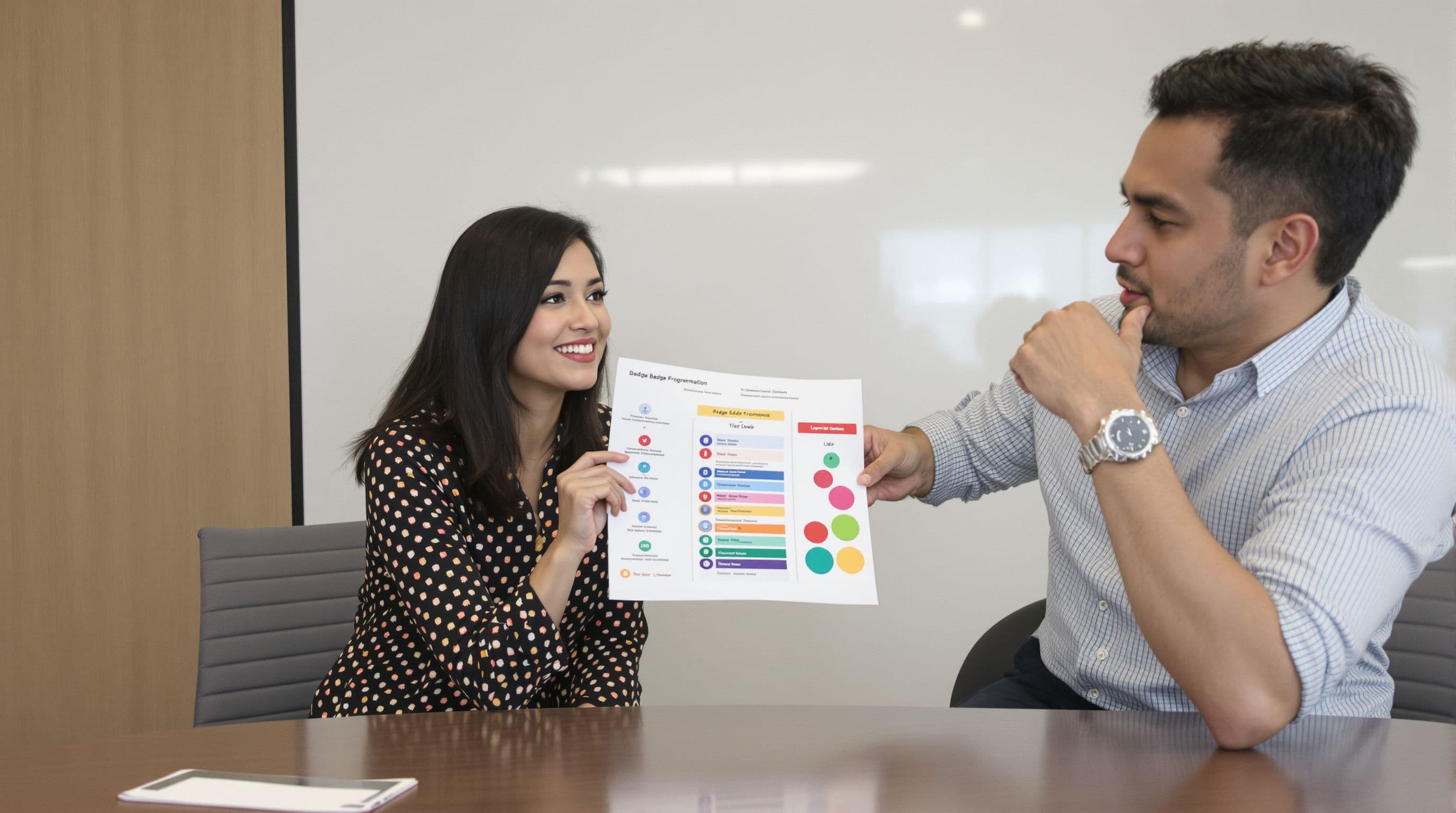
Most organizations investing in AI upskilling rely on external certifications as their primary credentialing mechanism. While these credentials serve a useful purpose in validating general AI competency, they cannot capture the specific tools, governance policies, and operational use cases that define how AI is actually deployed within a given enterprise. Internal AI badging programs fill precisely this gap, creating customized credentials that recognize organization-specific mastery and accelerate capability development in ways that generic certifications never will.
This guide outlines how to design and implement internal AI badging programs that complement external certifications and drive meaningful AI capability growth across the organization.
Why Internal AI Badging Programs Matter
Limitations of External Certifications
The fundamental challenge with external certifications is their generality. They cover broad concepts rather than the specific AI tools and workflows your teams use daily. They do not address your organization's AI governance framework, security requirements, or approved use cases. Certification bodies also tend to update their curricula slowly, lagging behind the pace at which enterprises adopt new AI tools and evolve their internal policies. The one-size-fits-all design means they cannot reflect the role-specific AI applications that matter in your particular context. Additionally, exam fees and prerequisite requirements create cost and access barriers that can limit participation across the workforce.
Benefits of Internal Badging
Internal badging programs offer advantages that external credentials structurally cannot. Badges can be designed for perfect alignment with what actually matters in your organization, addressing your specific tools, policies, and use cases with immediate applicability. Unlike external certifications with lengthy revision cycles, internal badges can be updated with agility as tools and policies evolve. They eliminate external costs and prerequisites, making them broadly accessible. They reinforce your organization's AI values and cultural approach. They create a visible recognition system that celebrates achievement and progress. And they enable granular progression paths that match organizational needs with far greater precision than any external framework.
Internal vs. External Credentials: The Optimal Mix
External Certifications Excel At
External certifications remain the stronger choice for foundational AI literacy and concepts, technical platform expertise across providers like Azure, AWS, and Google, and industry-standard governance frameworks such as the IAPP AI Governance Professional credential. They provide third-party validation and credibility that carries weight beyond your organization, offer market-portable credentials that employees value for career development, and enable benchmarking against external standards.
Internal Badges Excel At
Internal badges, by contrast, are purpose-built for organization-specific AI tools and platforms, company AI policies and governance requirements, approved use cases and workflows, and role-specific AI applications. They embed cultural values and approaches directly into the credentialing process, enable incremental skill recognition at a pace that matches real learning, and support rapid content updates as the AI landscape shifts.
Recommended Combination
The most effective credentialing strategy layers external certifications as the foundation for core AI literacy and platform expertise, then builds internal badges on top for organization-specific specialization. A typical pathway might begin with an external credential like Azure AI Fundamentals for general AI literacy, then progress through an internal "[Company] AI Policy & Governance Badge" covering company-specific rules, followed by a "[Company] Copilot Power User Badge" for company-specific Copilot usage, and culminate in a "[Role] AI Champion Badge" for role-specific advanced skills. An optional advanced external certification, such as the Microsoft Copilot Specialist, can cap the progression for those seeking deeper platform mastery.
Designing Your Internal AI Badging Program
Step 1: Define Program Goals
Before designing any badges, organizations must clarify what the program is meant to accomplish. The goals generally fall into four categories.
Competency verification ensures employees understand AI policies before receiving tool access, validates safe and effective AI usage, and identifies skill gaps that require targeted intervention. Development motivation creates visible progression paths, recognizes achievement and growth, and encourages voluntary skill building across the workforce. Cultural reinforcement celebrates AI adoption and proficiency, builds a community of AI champions, and normalizes AI learning and experimentation as everyday activities. Organizational visibility enables leadership to track AI capability distribution across teams, identify internal experts and mentors, and make informed decisions about training and resource allocation.
Clear goals shape every downstream decision about badge design and implementation.
Step 2: Identify Badge Categories
A well-structured badge portfolio typically spans several categories. Foundational badges, required for all employees, cover basics like "AI Essentials" for core awareness, "AI Governance & Policy" for company rules and compliance, and "Responsible AI Practices" for ethics and risk awareness. Tool-specific badges validate proficiency with particular platforms, such as "Microsoft 365 Copilot Certified," "[AI Platform] Power User," "AI Writing Assistant Proficient," or "AI Data Analytics Expert." Role-specific badges address functional applications, including "Sales AI Navigator," "HR AI Practitioner," "Finance AI Analyst," and "Marketing AI Specialist." Advanced mastery badges recognize deeper expertise, covering designations like "AI Champion" for internal experts and mentors, "AI Innovation Leader" for those identifying and piloting new use cases, and "AI Governance Specialist" for advanced governance knowledge. Project-based badges recognize applied contributions, such as "AI Project Contributor" for participation in AI initiatives and "AI Implementation Lead" for successfully leading AI deployments.
The recommended approach is to start with 5 to 10 badges and expand strategically based on adoption patterns and demonstrated organizational needs.
Step 3: Define Badge Requirements
Each badge needs clearly articulated requirements spanning knowledge, skill, and application components. Knowledge components include completing learning modules or courses, passing assessments such as quizzes or tests, and demonstrating conceptual understanding. Skill components involve completing practical exercises, submitting work samples or portfolio evidence, and demonstrating proficiency in realistic scenarios. Application components require using AI tools in real work (verified by manager or usage data), sharing learnings with teams or communities, and mentoring others or contributing to shared resources.
To illustrate, a "Microsoft 365 Copilot Certified" badge might require completing a two-hour "Copilot Fundamentals" e-learning module, passing a knowledge assessment at 80% or higher, submitting three examples of effective Copilot use in actual work, completing a "Copilot for [Your Role]" scenario exercise, and acknowledging understanding of Copilot data policies. A more advanced "AI Champion" badge might require holding at least three other AI badges, completing an "Advanced AI Techniques" course, leading or contributing to an AI community of practice, mentoring at least two colleagues in AI skills, sharing AI knowledge through a presentation or resource creation, and demonstrating innovation through new use case identification or implementation.
Step 4: Create Assessment Methods
Verification methods should be matched to badge importance and associated risk. Knowledge assessments range from multiple-choice quizzes (auto-graded and highly scalable) to scenario-based questions (testing realistic application) and short-answer responses (probing deeper understanding). Skills demonstrations can take the form of recorded video demonstrations, written work samples showing prompts, outputs, and refinements, live demonstrations to an assessor, or project portfolios. Manager verification involves confirming on-the-job application, completing behavioral observation checklists, or reviewing performance evidence. Usage analytics leverage AI tool usage metrics like frequency and quality indicators for automated skill-level inference, though this approach requires careful attention to privacy and transparency. Peer review enables colleagues to verify collaboration and mentoring contributions, supports 360-degree feedback for leadership badges, and can incorporate community voting or endorsement. Self-attestation, where employees confirm completion and understanding, offers the lowest rigor but the fastest and most accessible pathway, making it appropriate for low-stakes awareness badges.
Step 5: Design Badge Visual Identity
Badges should be visually distinctive and appealing to maximize their motivational impact. A consistent design system across all badges, color coding by category or level, icons representing each badge's focus area, organization branding elements, and level indicators (such as bronze, silver, and gold tiers) all contribute to a professional and recognizable visual identity.
On the digital side, adopting the Open Badges standard ensures portability, while embedding metadata covering the issuer, criteria, and date earned supports display on profiles and digital platforms. Integration with professional networks extends the badge's visibility and value. Optional physical recognition through printed certificates, badge pins, desk plaques, or team recognition boards can reinforce the program's visibility in office environments.
Implementing Your Badging Program
Technology Platform Selection
Organizations have several technology options for delivering their badging program. LMS-integrated badging, available through platforms like Cornerstone, Docebo, and Absorb, offers seamless integration with training content and automatic badge award upon completion. Specialized badging platforms such as Credly, Badgr, and Accredible provide dedicated badge management, advanced features and analytics, and native Open Badges standard support. HR system integration connects badges to HRIS and talent profiles, making them visible in performance management and creating potential ties to compensation or advancement, though this may require system capabilities or custom development. Custom development offers complete control and customization with integration into any internal system, but carries higher development and maintenance costs and is typically best suited for large organizations with highly specific requirements.
Selection criteria should include integration with existing systems (LMS, HRIS, intranet), user experience and accessibility, cost and scalability, reporting and analytics capabilities, Open Badges standard support, and vendor support reliability.
Program Launch Strategy
A phased approach reduces risk and builds momentum. The pilot phase, spanning two to three months, should launch with three to five initial badges targeting an enthusiastic early adopter group of 50 to 200 people. This phase focuses on gathering feedback about badge requirements, assessments, and processes, refining the program based on pilot learnings, and celebrating pilot participants and early badge earners.
The subsequent phased rollout proceeds in waves. Wave 1 introduces required foundational badges for all employees. Wave 2 adds role-specific and tool-specific badges. Wave 3 introduces advanced and mastery badges. Wave 4 incorporates project-based and innovation badges.
A strong communication campaign underpins the entire launch, featuring executive endorsement and visible participation, a clear value proposition answering "What's in it for me?", success stories and testimonials from early participants, regular updates on new badges and achievements, and tight integration with broader AI adoption messaging.
Governance and Administration
Effective program governance requires clear ownership. An executive sponsor (typically the CHRO, CTO, or Chief AI Officer) provides strategic direction. A dedicated program manager handles day-to-day operations. A badge governance committee approves new badges and changes to existing ones. Subject matter experts and assessors review evidence and award badges.
Badge lifecycle management encompasses the full span of each credential. Creation involves a formal process for proposing and approving new badges. Maintenance requires regular review and updating of requirements as tools and policies evolve. Retirement provides a clear path for sunsetting outdated or redundant badges. Versioning manages badge updates over time so that holders of previous versions are treated fairly.
Quality assurance mechanisms include inter-rater reliability testing for assessed badges, audit processes to prevent gaming or fraud, an appeals process for disputed decisions, and regular program evaluation driving continuous improvement.
Driving Badge Program Adoption
Intrinsic Motivation
The most durable adoption drivers are intrinsic. Badges provide clear skill development paths, and visible progress motivates continued effort. Recognition of achievement satisfies a fundamental need for accomplishment. Voluntary participation empowers choice, while multiple badge paths allow personalization and self-paced progression respects individual schedules. As employees advance through badge levels, they signal increasing expertise to themselves and their peers, with advanced badges providing aspirational goals and skill demonstration building genuine confidence.
Extrinsic Motivation
External incentives reinforce intrinsic motivation when designed thoughtfully. Public recognition through badge display on internal profiles, celebrations in company communications, and team or department achievement recognition raises visibility. Career benefits can include badge requirements for certain roles or projects, consideration in performance reviews, preference for badge holders in AI-related opportunities, and connection to promotion or advancement criteria. Tangible rewards such as branded merchandise, professional development budget increases, conference attendance, or learning opportunities provide additional pull. Manager engagement is particularly powerful; when managers actively encourage badge pursuit, set team goals that include badge achievement targets, protect time for badge-related learning, and recognize team member achievements, participation rates climb significantly.
Social and Community Elements
Social dynamics multiply the program's impact. Badge holder communities with exclusive channels, networking and peer learning opportunities, early access to new tools, and input on AI strategy create a sense of belonging that drives continued participation. Peer learning, where badge holders mentor others, form study groups, share resources, and pursue badges collaboratively, extends the program's reach well beyond its formal structure. Friendly competition through team badge achievement challenges, department leaderboards (used carefully to avoid negative dynamics), badge collection gamification, and recognition of "first to earn" milestones adds energy and engagement.
Measuring Program Success
Effective measurement spans four dimensions. Participation metrics track the percentage of employees who have earned at least one badge, the average number of badges per employee, the time from program launch to first badge earned, completion rates for started badges, and distribution across badge types and levels. Quality metrics examine the correlation between badge attainment and performance outcomes, manager satisfaction with badge holder capabilities, badge holder confidence and self-efficacy, and assessment consistency through inter-rater reliability. Business impact metrics connect the program to outcomes that matter, including AI tool adoption rates among badge holders versus non-holders, productivity or efficiency gains where measurable, reduction in AI-related incidents or support tickets, increased innovation through new use cases and improvements, and faster AI capability deployment. Program health metrics gauge employee satisfaction with the badging program, perceived fairness and accessibility, badge value and recognition, and overall program awareness and understanding.
Common Pitfalls and How to Avoid Them
Too Many Badges Too Soon
Launching with more than 20 badges overwhelms employees and dilutes the value of each credential. The solution is to start with 5 to 10 core badges and expand only based on demonstrated need and healthy adoption of existing badges.
Requirements Too Easy or Too Hard
Trivial badges lack credibility and fail to motivate, while badges with impossible requirements discourage pursuit entirely. The solution is to pilot badges with representative users and adjust requirements based on their feedback and completion data.
Neglecting Maintenance
Badges become outdated as AI tools and organizational policies evolve, eroding the program's relevance. The solution is to establish a quarterly review cycle and proactively sunset or update badges before they lose currency.
Weak Connection to Work
Badges that do not reflect real job requirements feel arbitrary and fail to earn respect from employees or managers. The solution is to design badges with direct input from managers and practitioners, tying requirements directly to role responsibilities.
No Recognition or Reward
Badges that provide no benefit beyond the credential itself inevitably lose their appeal. The solution is to integrate badges into talent management systems, provide meaningful recognition, and create tangible benefits for badge holders.
Inequitable Access
When some employees cannot access badging due to time constraints, resource limitations, or structural barriers, the program risks becoming exclusionary. The solution is to ensure broad accessibility, provide dedicated work time for badge pursuit, and remove unnecessary prerequisites.
Gaming and Fraud
Employees may attempt to shortcut requirements or falsify evidence, undermining the program's integrity. The solution is to implement robust verification mechanisms, establish clear consequences for dishonesty, and consistently emphasize learning over credentialing.
Integration with External Certifications
Internal badges should complement external certifications rather than compete with them. Prerequisite relationships can work in either direction; an external certification like Azure AI-102 might be required for an internal "[Company] AI Architecture Badge," or an internal badge might be required before the organization sponsors an employee for an external certification. Equivalency recognition, where an external certification automatically awards the related internal badge, reduces redundant assessment and respects employees' prior achievement. Stacked credentials create a progression where internal badges prepare employees for external certifications, and external certifications in turn unlock advanced internal badges. The complementary focus is straightforward: external credentials validate general AI platform skills, while internal badges validate the application of those skills in the company's specific context.
Scaling Your Program
The path from pilot to enterprise-wide deployment unfolds across four phases. Phase 1, spanning months one through three, involves piloting with early adopters using three to five badges and 50 to 200 participants. Phase 2, covering months four through six, expands to a broader population with the addition of role-specific badges and targets 500 to 1,000 participants. Phase 3, running from months seven through twelve, constitutes the organization-wide rollout with a comprehensive badge portfolio and a target of 50% or greater participation. Phase 4, beginning in year two and continuing indefinitely, represents a mature program with continuous improvement, advanced badges, and deep integration into organizational talent systems.
Key indicators of readiness to scale include high pilot satisfaction and completion rates, stable badge requirements and assessment processes, adequate support resources and infrastructure, clear demand from the broader organization, and strong executive and manager endorsement.
Future of Internal AI Badging
Several emerging trends are reshaping the trajectory of internal badging programs. AI-powered personalization will enable adaptive badge recommendations based on each employee's role, existing skills, and development goals. Automated assessment through AI evaluation of work samples and demonstrations will reduce the administrative burden on human reviewers. Micro-credentials, offering smaller and more granular badges that stack into comprehensive credentials, will provide finer-grained recognition of incremental learning. Cross-organization recognition through industry consortiums sharing badge standards will extend the value of internal credentials beyond company walls. Blockchain verification will enable tamper-proof credential validation. Real-time skill verification through continuous assessment of actual work, rather than one-time testing, will make badges a living reflection of current capability.
Conclusion
Internal AI badging programs provide tailored, agile, and accessible recognition of organization-specific AI capabilities that external certifications cannot address. They complement generic credentials by covering the company-specific tools, governance policies, and use cases that define how AI is actually used in practice.
The organizations that succeed with these programs start small with 5 to 10 well-designed badges, pilot with enthusiastic early adopters, integrate deeply with existing talent management systems, and scale based on demonstrated value. The payoff is significant: accelerated AI capability development, visible skill progression across the workforce, and a culture that actively celebrates AI learning and innovation.
Common Questions
Both. External certifications provide foundational AI literacy and platform expertise with third-party validation. Internal badges address your specific tools, policies, and use cases that external certifications can't cover. Optimal approach: external certifications for core competencies, internal badges for organization-specific mastery. This combination provides comprehensive capability recognition.
Start with 5-10 core badges covering foundational requirements (AI policy, responsible AI, primary tool proficiency) and expand based on adoption and need. Launching with 20+ badges overwhelms employees and dilutes value. Add role-specific and advanced badges once foundational badges show strong participation. Mature programs may have 20-30 badges across levels and specializations.
Depends on existing infrastructure. If you have an LMS, use built-in badging features for seamless integration. For advanced features and Open Badges standard support, consider specialized platforms like Credly or Badgr ($1-5 per employee annually). Large organizations with specific needs may build custom solutions. Prioritize integration with existing systems over features alone.
Design multi-faceted requirements (knowledge + skills demonstration + application). Include manager verification for important badges. Use randomized scenario-based questions. Monitor completion patterns for suspicious activity. Focus on learning over credentialing—emphasize that badges recognize capability, not just box-checking. Establish clear consequences for fraud but avoid creating punitive environment that discourages honest participation.
Hybrid approach works best. Require foundational badges (AI policy, governance, basic literacy) for all employees before AI tool access. Make advanced, role-specific, and mastery badges voluntary for motivation and autonomy. Required badges ensure baseline safety and compliance; voluntary badges drive engagement and advanced skill development without creating burden.
References
- AI Risk Management Framework (AI RMF 1.0). National Institute of Standards and Technology (NIST) (2023). View source
- ISO/IEC 42001:2023 — Artificial Intelligence Management System. International Organization for Standardization (2023). View source
- Training Subsidies for Employers — SkillsFuture for Business. SkillsFuture Singapore (2024). View source
- HRD Corp — Employer Training Programs & Grants. Human Resources Development Fund (HRDF) Malaysia (2024). View source
- Model AI Governance Framework (Second Edition). PDPC and IMDA Singapore (2020). View source
- Enterprise Development Grant (EDG) — Enterprise Singapore. Enterprise Singapore (2024). View source
- OECD Principles on Artificial Intelligence. OECD (2019). View source
