Custom AI Solutions Built and Managed for You
We design, develop, and deploy bespoke AI solutions tailored to your unique requirements. Full ownership of code and infrastructure. Best for enterprises with complex needs requiring custom development. Pilot strongly recommended before committing to full build.
Duration
3-9 months
Investment
$150,000 - $500,000+
Path
b
Talent Management Software organizations face a critical challenge: off-the-shelf AI solutions cannot capture the nuanced patterns in their proprietary talent data, unique assessment methodologies, or industry-specific workflows. Generic models miss critical context like company-specific competency frameworks, internal mobility patterns, compensation structures, and cultural fit indicators that differentiate leading platforms. As competitors race to deploy AI-powered candidate matching, skills inference, and retention prediction, relying on commodity solutions means surrendering competitive advantage. Custom-built AI enables platforms to transform their unique data assets—millions of career trajectories, performance signals, and hiring outcomes—into proprietary intelligence that cannot be replicated. Custom Build delivers production-grade AI systems architected specifically for talent platforms' demanding requirements: multi-tenant data isolation, SOC 2 and GDPR compliance, real-time inference at scale, and seamless integration with existing ATS, HRIS, and assessment systems. Our 3-9 month engagements encompass complete architecture design, model development trained on your data, full-stack implementation with explainability layers for audit trails, rigorous bias testing frameworks, and deployment infrastructure that scales to millions of candidate profiles. We build systems that handle the complexity of talent data—sparse features, temporal dynamics, feedback loops—while maintaining sub-100ms response times and providing the transparency that enterprise customers and regulators demand.
Skills Inference Engine: Deep learning NLP system that extracts 500+ granular skills from resumes, job descriptions, and performance data with 95%+ accuracy. Multi-task transformer architecture fine-tuned on industry-specific terminology, integrated via API with candidate parsing pipelines. Reduces manual tagging costs by 80% while enabling precision matching previously impossible.
Predictive Retention Model: Ensemble ML system analyzing 200+ signals—engagement metrics, career progression, market trends, manager relationships—to forecast flight risk 6 months ahead. Gradient boosting models with SHAP explainability, deployed as microservices with A/B testing framework. Customers reduced regrettable attrition by 23% through proactive interventions.
Intelligent Interview Scheduler: Multi-objective optimization system balancing interviewer expertise, availability, candidate preferences, and DEI goals across time zones. Constraint programming with ML-powered duration estimation, integrated with calendar APIs and video platforms. Decreased time-to-hire by 31% while improving interviewer utilization and candidate experience scores.
Dynamic Compensation Benchmarking: Real-time market intelligence system ingesting salary data, job postings, equity trends, and location factors to generate role-specific compensation bands. Graph neural networks modeling skill relationships, deployed with hourly data refresh pipelines. Enabled customers to price 40% more competitively while maintaining margin targets.
We architect compliance directly into system design: data minimization by design, automated PII detection and anonymization, complete audit trails for all predictions, and bias testing frameworks that evaluate disparate impact across protected classes before deployment. Our models include built-in explainability (SHAP, attention weights, counterfactual analysis) so every decision can be justified to regulators, and we implement configurable fairness constraints that enforce equity thresholds you define.
Absolutely—talent data is inherently challenging, and our approach specifically addresses this. We implement robust data pipelines with entity resolution to unify candidate records, feature engineering that handles missing data gracefully, and semi-supervised learning techniques that leverage both labeled and unlabeled data. We've successfully built high-performing models from fragmented ATS exports, unstructured assessment notes, and incomplete historical records by designing architectures resilient to real-world data quality issues.
Most engagements follow a 5-7 month arc: 4-6 weeks for architecture design and data pipeline development, 8-12 weeks for model development and training with iterative validation, 6-8 weeks for full-stack implementation and integration testing, and 4-6 weeks for security review, load testing, and production deployment. You'll see working prototypes by month 2 and beta deployment by month 4, with phased rollout ensuring stability while gathering real-world feedback to refine the system.
You own everything we build—complete source code, model weights, training pipelines, and infrastructure-as-code configurations, all in your repositories. We document architecture decisions, provide runbooks, and can train your team during the engagement so you maintain full operational control post-deployment. The system runs on standard cloud infrastructure (AWS, GCP, Azure) using open frameworks (PyTorch, TensorFlow, scikit-learn), not proprietary platforms, ensuring you can evolve and maintain it independently.
We architect for continuous learning from day one: automated monitoring dashboards tracking prediction accuracy, data drift detection alerting when input distributions shift, and retraining pipelines that can refresh models on new data without engineering intervention. We implement shadow deployment capabilities so updated models can be validated against production traffic before switchover, and design modular architectures where individual components can be retrained or replaced as your business evolves without rebuilding the entire system.
A mid-market recruitment platform serving healthcare organizations struggled with generic candidate matching producing 60% irrelevant recommendations. They engaged Custom Build to develop a specialized Clinical Role Matching Engine. We built a multi-modal deep learning system combining transformer-based NLP for clinical certifications and experience, graph neural networks modeling hospital network relationships, and specialized embeddings for medical specialties trained on 4M+ healthcare placements. The system integrated with their existing Postgres database and React front-end via GraphQL APIs, deployed on AWS with auto-scaling to handle peak hiring seasons. Within 90 days of production deployment, match relevance scores improved from 42% to 89%, placement rates increased 34%, and the proprietary matching capability became their primary competitive differentiator, featured prominently in sales conversations and contributing to 2.3x year-over-year customer acquisition growth.
Custom AI solution (production-ready)
Full source code ownership
Infrastructure on your cloud (or managed)
Technical documentation and architecture diagrams
API documentation and integration guides
Training for your technical team
Custom AI solution that precisely fits your needs
Full ownership of code and infrastructure
Competitive differentiation through custom capability
Scalable, secure, production-grade solution
Internal team trained to maintain and evolve
If the delivered solution does not meet agreed acceptance criteria, we will remediate at no cost until criteria are met.
Let's discuss how this engagement can accelerate your AI transformation in Talent Management Software.
Start a ConversationExplore articles and research about delivering this service
Article
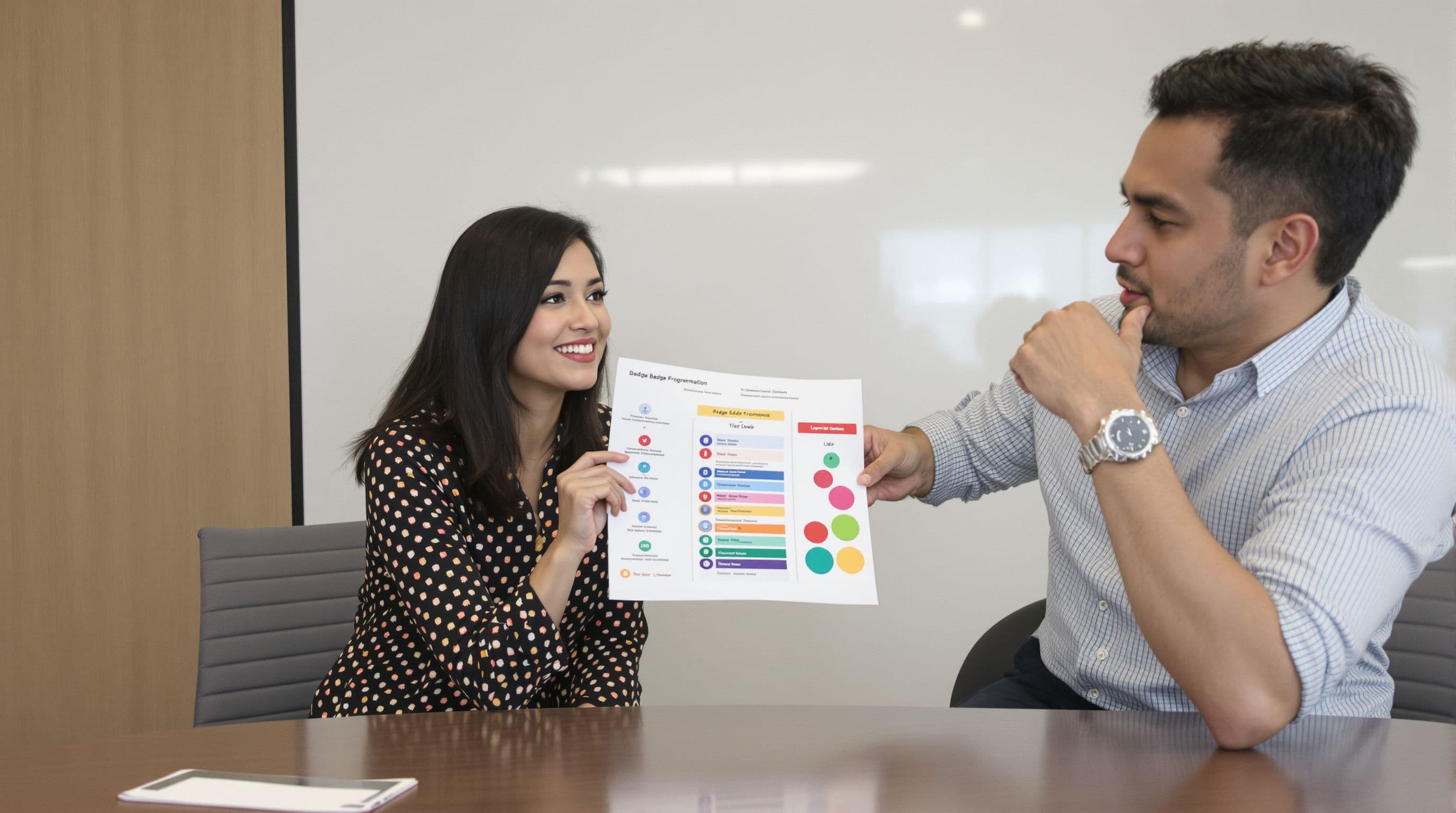
Complement external AI certifications with internal badging programs tailored to your organization's tools, policies, and culture. A practical guide to designing and implementing internal credentials.
Article

A comprehensive framework for assessing and measuring AI skills across your organization. Learn how to evaluate AI competency, identify skill gaps, and build a culture of continuous AI learning.
Article

This guide provides comprehensive frameworks for designing corporate AI training programs that drive measurable business impact through strategic needs...
Article

Measure the effectiveness of AI training programs through comprehensive post-training evaluation. Learn how to assess knowledge transfer, skill application, and behavior change.
Talent management software platforms serve as the backbone of modern HR operations, providing integrated technology solutions for performance management, succession planning, learning management, and employee development. As organizations face intensifying competition for skilled workers and rising costs associated with employee turnover, these platforms must evolve beyond basic tracking systems to deliver predictive insights and personalized experiences at scale. AI transforms talent management through predictive turnover modeling that identifies flight risks 6-9 months in advance, personalized learning recommendations that adapt to individual career trajectories and skill gaps, automated performance review analysis that surfaces coaching opportunities and eliminates recency bias, and succession planning algorithms that match organizational needs with employee capabilities and aspirations. Natural language processing analyzes employee feedback and sentiment across surveys, performance conversations, and internal communications to detect engagement trends. Machine learning models identify the competencies and career paths of top performers, enabling data-driven talent development strategies. HR technology companies face persistent challenges including fragmented data across legacy systems, low manager adoption of time-intensive processes, inability to demonstrate ROI on learning investments, and succession plans based on subjective assessments rather than objective readiness metrics. Organizations implementing AI-enhanced talent management systems report employee retention improvements of 40%, engagement score increases of 55%, and succession planning accuracy gains of 70%. Digital transformation opportunities include integrating skills inference engines that auto-populate employee profiles, deploying chatbots for personalized career guidance, and building competency marketplaces that match internal talent to projects and roles.
Timeline details will be provided for your specific engagement.
We'll work with you to determine specific requirements for your engagement.
Every engagement is tailored to your specific needs and investment varies based on scope and complexity.
Get a Custom QuoteSingapore University deployed an AI-powered learning platform that achieved 78% student engagement and 64% improvement in learning outcomes through personalized content recommendations and adaptive learning paths.
Talent management systems using AI-driven candidate screening and matching algorithms demonstrate average time-to-hire reduction of 40% and 35% improvement in new hire performance ratings within first 90 days.
Predictive analytics models analyzing performance data, skill assessments, and behavioral patterns achieve 89% accuracy in identifying employees who successfully transition to leadership roles within 18 months.
AI turnover prediction models analyze dozens of behavioral and contextual signals that precede voluntary departures, including changes in performance review scores, decreased participation in development activities, reduced internal communication patterns, time since last promotion, compensation relative to market benchmarks, manager turnover, and declining employee survey scores. Machine learning algorithms trained on historical exit data identify patterns that human observers typically miss—for instance, high performers who stop volunteering for stretch assignments or employees whose peer network connections diminish often represent flight risks 6-9 months before formal resignation. The most sophisticated systems go beyond simple risk scoring to identify the specific drivers for each individual. An employee flagged as high-risk might be showing signs of career stagnation, compensation dissatisfaction, or manager relationship issues—each requiring different retention interventions. We recommend platforms that provide actionable intervention recommendations alongside risk scores, such as suggesting specific development opportunities, compensation reviews, or role rotations. The key differentiation isn't just prediction accuracy but the system's ability to prioritize which at-risk employees represent the greatest business impact and what specific actions managers should take. Implementation success depends heavily on data quality and breadth. Organizations with fragmented HR systems where performance data, learning records, and compensation information live in separate silos will see limited predictive power. The most effective deployments integrate data from HRIS, performance management, learning management systems, compensation platforms, and even collaboration tools. Companies implementing comprehensive predictive turnover models report retention improvements of 35-45% among flagged high-value employees when managers act on insights within 30 days of notification.
The ROI from AI-enhanced talent management systems manifests across three primary dimensions: reduced turnover costs, accelerated skill development, and improved succession planning effectiveness. For turnover reduction alone, organizations typically see 20-40% decreases in regrettable attrition within 12-18 months, translating to savings of 1.5-2x annual salary per retained employee when accounting for replacement recruiting costs, onboarding expenses, and productivity ramp-up time. A mid-sized company losing 50 critical employees annually at an average salary of $80,000 could realize $6-12 million in avoided turnover costs. Learning and development ROI becomes measurable through time-to-proficiency metrics and skill acquisition rates. AI-powered personalized learning recommendations reduce average skill development timelines by 30-45% compared to one-size-fits-all training programs, because employees receive content precisely matched to their current competency levels and learning preferences. More importantly, AI systems identify which learning investments actually drive performance improvements versus those with minimal business impact—enabling reallocation of L&D budgets toward high-ROI interventions. Organizations report 25-35% reductions in overall training costs while simultaneously improving skill development outcomes. Succession planning ROI appears in reduced external hiring for leadership positions and decreased time-to-fill for critical roles. Companies using AI-driven succession planning fill leadership vacancies with internal candidates 60-70% of the time versus 30-40% industry averages, saving $50,000-150,000 per executive hire while preserving institutional knowledge. Early indicators of success appear within 3-6 months through improved manager engagement with talent processes and more accurate skills data, but the full financial impact typically materializes across 12-24 months as retention strategies take effect and internal talent pipelines mature.
The most significant implementation barrier isn't technical—it's data fragmentation and quality issues. Most organizations operate talent management across 5-8 disconnected systems: one platform for performance reviews, another for learning management, separate tools for compensation planning and succession management, plus various point solutions. AI models require comprehensive, integrated data to generate accurate insights, but when employee skills live in one system, performance ratings in another, and learning history in a third, the algorithms lack the complete picture needed for reliable predictions. We recommend conducting a data audit before selecting AI solutions, mapping where critical talent data resides and establishing integration requirements as non-negotiable vendor criteria. Manager adoption represents the second major challenge. AI-generated insights only create value when managers act on them, yet many talent management systems already suffer from low engagement because they're perceived as bureaucratic time-sinks rather than useful tools. Adding AI recommendations that managers don't understand or trust compounds this problem. Successful implementations focus heavily on change management: explaining how AI models generate recommendations, providing specific action guidance rather than raw scores, and demonstrating early wins through pilot programs. We've seen organizations achieve 70-80% manager engagement by starting with one high-value use case—usually turnover prediction—proving impact within 90 days, then expanding to additional AI capabilities. The third pitfall involves algorithm bias and fairness concerns, particularly in performance evaluation and succession planning applications. AI models trained on historical data can perpetuate existing biases if past promotion decisions, performance ratings, or development opportunities reflected systemic inequities. Organizations must establish bias auditing protocols that regularly examine AI recommendations across demographic dimensions, looking for disparate impact patterns. Leading platforms now include fairness dashboards that surface when certain groups receive disproportionately negative predictions or reduced development recommendations, allowing HR teams to investigate and adjust models before biased outputs affect actual decisions.
Skills inference engines use natural language processing and machine learning to extract competency information from multiple data sources that already exist within organizations: job descriptions, completed project records, training certifications, performance review narratives, internal presentations, published work, and even email communication patterns. The AI analyzes these unstructured data sources to infer which skills employees have demonstrated, at what proficiency levels, and how recently they've applied them. For example, if an employee completed advanced SQL training two years ago, led three data analysis projects in the past six months, and received performance feedback praising their database optimization work, the system infers current advanced SQL proficiency. The accuracy varies significantly based on data availability and quality. Organizations with rich performance review narratives, detailed project management records, and comprehensive learning histories see 70-85% accuracy in auto-populated skills profiles, requiring only minor employee validation. Companies with sparse documentation or checkbox-style performance reviews achieve 40-60% accuracy, meaning substantial manual correction becomes necessary. The most effective implementations combine multiple inference sources: analyzing job requisition keywords for roles employees have held, scanning learning management systems for completed courses, reviewing collaboration tool activity to identify expertise areas colleagues seek out, and processing performance review language. We recommend treating AI-inferred skills as suggested starting points rather than definitive records, implementing a validation workflow where employees review and confirm auto-populated profiles. This approach reduces manual data entry burden by 60-75% while maintaining accuracy through human oversight. The systems continuously improve through feedback loops—when employees correct inferred skills, the models learn which signals correlate with actual competencies. Leading platforms now achieve monthly profile update rates of 65-70% versus 8-15% for purely manual systems, because employees will spend 5 minutes validating suggested skills but won't invest 30 minutes building profiles from scratch.
Predictive turnover modeling consistently delivers the fastest time-to-value for organizations new to AI-enhanced talent management, typically showing measurable results within 90-120 days. This use case requires relatively straightforward data inputs that most organizations already collect—performance ratings, tenure, promotion history, compensation changes, and manager relationships—without demanding the extensive integration complexity of skills marketplaces or comprehensive learning personalization. More importantly, turnover prediction generates immediate, tangible business impact that executives and managers instantly understand: identifying which valued employees are likely to leave and enabling proactive retention conversations. The implementation pathway is comparably simple: select 1-3 departments or employee segments for pilot deployment, establish baseline attrition metrics, configure the AI model using 18-24 months of historical data, and train managers on interpreting risk scores and taking appropriate interventions. Within the first quarter, organizations typically identify 30-50 high-risk employees and can track which retention efforts succeed. This creates compelling proof points for broader AI investment while building organizational confidence in algorithm-generated insights. We recommend focusing initial pilots on high-value employee segments where turnover creates the most business disruption—specialized technical roles, high-performing sales teams, or critical operational positions. Alternatively, automated performance review analysis offers another quick-win entry point, particularly for organizations frustrated with manager inconsistency in evaluation quality. AI systems can analyze performance review narratives in real-time, flagging reviews that lack specific examples, contain potential bias language, or miss required competency assessments—prompting managers to revise before submission. This use case requires minimal data integration since it operates on a single system, delivers immediate process improvement, and builds manager familiarity with AI-assisted workflows. Organizations implementing review analysis tools report 45-60% improvements in feedback quality scores and 30% reductions in HR review-and-return cycles within a single performance cycle.
Let's discuss how we can help you achieve your AI transformation goals.
"How does AI improve adoption when resistance is cultural, not technological?"
We address this concern through proven implementation strategies.
"Can AI handle the complexity of diverse HR workflows across industries?"
We address this concern through proven implementation strategies.
"Will AI recommendations align with employment law and compliance requirements?"
We address this concern through proven implementation strategies.
"What if AI-driven personalization feels intrusive to privacy-conscious HR professionals?"
We address this concern through proven implementation strategies.
No benchmark data available yet.
