Aggregate feedback from managers, peers, and self-reviews. Identify themes, strengths, development areas, and generate draft performance summaries and development plans. Distilling performance evaluation narratives through [natural language processing](/glossary/natural-language-processing) transforms voluminous manager commentary, peer feedback submissions, and self-assessment reflections into actionable development summaries. Extractive summarization algorithms identify salient accomplishment descriptions, behavioral competency observations, and developmental recommendation passages from multi-rater feedback collections spanning quarterly check-in notes, project retrospective contributions, and annual appraisal documentation. Sentiment trajectory analysis charts emotional valence evolution across successive review periods, distinguishing between consistently positive performers, improving trajectories warranting recognition, declining patterns requiring intervention, and volatile assessment histories suggesting environmental or managerial inconsistency. Longitudinal competency radar visualizations overlay multi-period ratings across organizational capability frameworks, revealing strengthening proficiencies and persistent development areas requiring targeted investment. Calibration support tooling aggregates summarized performance data across organizational units, enabling human resource business partners to facilitate equitable rating distribution conversations. Statistical outlier detection flags departments exhibiting suspiciously uniform rating distributions suggesting calibration avoidance, or conversely, departments with bimodal distributions indicating potential favoritism or discrimination patterns requiring deeper examination. Behavioral anchored rating scale alignment validates that narrative commentary substantiates assigned numerical ratings, identifying misalignment instances where effusive qualitative descriptions accompany mediocre quantitative scores or where critical narrative observations contradict above-average ratings. This consistency enforcement strengthens the evidentiary foundation supporting compensation differentiation, promotion decisions, and performance improvement plan initiation. Compensation linkage analysis correlates summarized performance outcomes with merit increase recommendations, bonus allocation proposals, and equity grant suggestions, ensuring pay-for-performance alignment satisfies board compensation committee governance expectations. Pay equity [regression](/glossary/regression) analysis simultaneously verifies that performance-linked compensation adjustments do not produce statistically significant disparities across protected demographic categories. Goal completion extraction quantifies objective achievement rates from narrative descriptions, transforming qualitative accomplishment narratives into structured metrics suitable for balanced scorecard aggregation. Natural language [inference](/glossary/inference-ai) models determine whether described outcomes satisfy, partially fulfill, or fall short of established goal criteria, reducing subjective interpretation variance across evaluating managers. Succession planning integration feeds summarized competency profiles and development trajectory assessments into talent pipeline databases, enabling leadership development teams to identify high-potential candidates demonstrating readiness indicators for advancement consideration. Nine-box grid positioning recommendations derive from algorithmic synthesis of performance consistency, competency breadth, learning agility indicators, and organizational impact assessments. Privacy-preserving summarization techniques ensure generated summaries exclude protected health information, accommodation details, leave of absence references, and other confidential elements that should not propagate beyond original evaluation contexts. Personally identifiable information redaction operates as a mandatory post-processing filter before summarized content enters talent management databases accessible to broader organizational audiences. Legal defensibility enhancement generates documentation packages supporting employment decisions by assembling chronological performance evidence, progressive counseling records, and improvement plan outcomes into coherent narratives that employment litigation counsel can leverage during wrongful termination or discrimination claim responses. Continuous feedback synthesis extends beyond formal review cycles to aggregate real-time recognition platform entries, peer kudos submissions, and project completion assessments into rolling performance portraits that reduce recency bias inherent in annual evaluation frameworks by presenting representative accomplishment distributions across entire assessment periods. Nine-box talent calibration grid positioning algorithms synthesize manager-submitted performance ratings and potential assessments against organizational norm distributions, detecting central tendency bias, leniency inflation, and range restriction artifacts that necessitate forced-ranking recalibration before succession planning pipeline population and high-potential identification deliberations. Competency framework alignment scoring maps extracted behavioral indicator mentions against organization-specific capability architecture definitions, computing proficiency-level gap magnitudes between demonstrated and target-role mastery thresholds across technical, leadership, and interpersonal competency domain taxonomies for individualized development plan generation. Halo effect debiasing algorithms detect evaluator rating inflation patterns through hierarchical Bayesian mixed-effects modeling that isolates genuine performance variance from systematic rater leniency coefficients. Succession pipeline readiness taxonomies classify developmental trajectory indicators against competency architecture proficiency rubrics spanning technical mastery and interpersonal effectiveness dimensions.
1. Manager collects feedback from 5-10 people (1 week wait) 2. Manually reads all feedback (1 hour) 3. Identifies common themes and patterns (30 min) 4. Writes performance summary (1 hour) 5. Creates development plan (30 min) 6. Reviews and edits (30 min) Total time: 3.5 hours + 1 week collection time
1. AI automatically collects feedback via surveys 2. AI analyzes all feedback for themes 3. AI identifies strengths and development areas 4. AI generates draft performance summary 5. AI suggests development plan actions 6. Manager reviews, personalizes, finalizes (30 min) Total time: 30-45 minutes + automatic collection
Risk of over-generalizing feedback nuance. May miss important context from individual comments. Sensitive handling of negative feedback required.
Manager review and personalization requiredAccess to original feedback alongside summaryConfidentiality of individual feedback maintainedRegular calibration with HR
Most organizations can deploy performance review summarization within 6-8 weeks, including data integration and model training. The timeline depends on your existing HRIS integration complexity and the volume of historical review data available for training. Pilot programs with a single department can be live in as little as 3-4 weeks.
You'll need at least 12-18 months of historical performance review data, including manager feedback, peer reviews, and self-assessments in structured or semi-structured formats. The system works best with standardized review templates and competency frameworks already in place. Clean employee data with consistent job roles and reporting structures is also essential for accurate theme identification.
Organizations typically see 60-70% reduction in time spent on review compilation, translating to 8-12 hours saved per manager per review cycle. For a company with 100 managers conducting bi-annual reviews, this represents approximately $50,000-75,000 in productivity savings annually. Additional ROI comes from more consistent, comprehensive feedback and faster development plan creation.
The primary risks include potential bias amplification if historical review data contains systemic biases, and over-reliance on AI-generated summaries without human oversight. Privacy and data security concerns are critical since performance data is highly sensitive. Mitigation requires bias testing, mandatory human review of AI outputs, and robust data governance protocols.
Expect initial setup costs of $25,000-50,000 for enterprise implementations, plus ongoing SaaS fees of $8-15 per employee per month. Custom integrations with existing talent management platforms may add 20-30% to initial costs. Most vendors offer pilot pricing starting at $5,000-10,000 for departments of 50-100 employees.
Explore articles and research about implementing this use case
Article
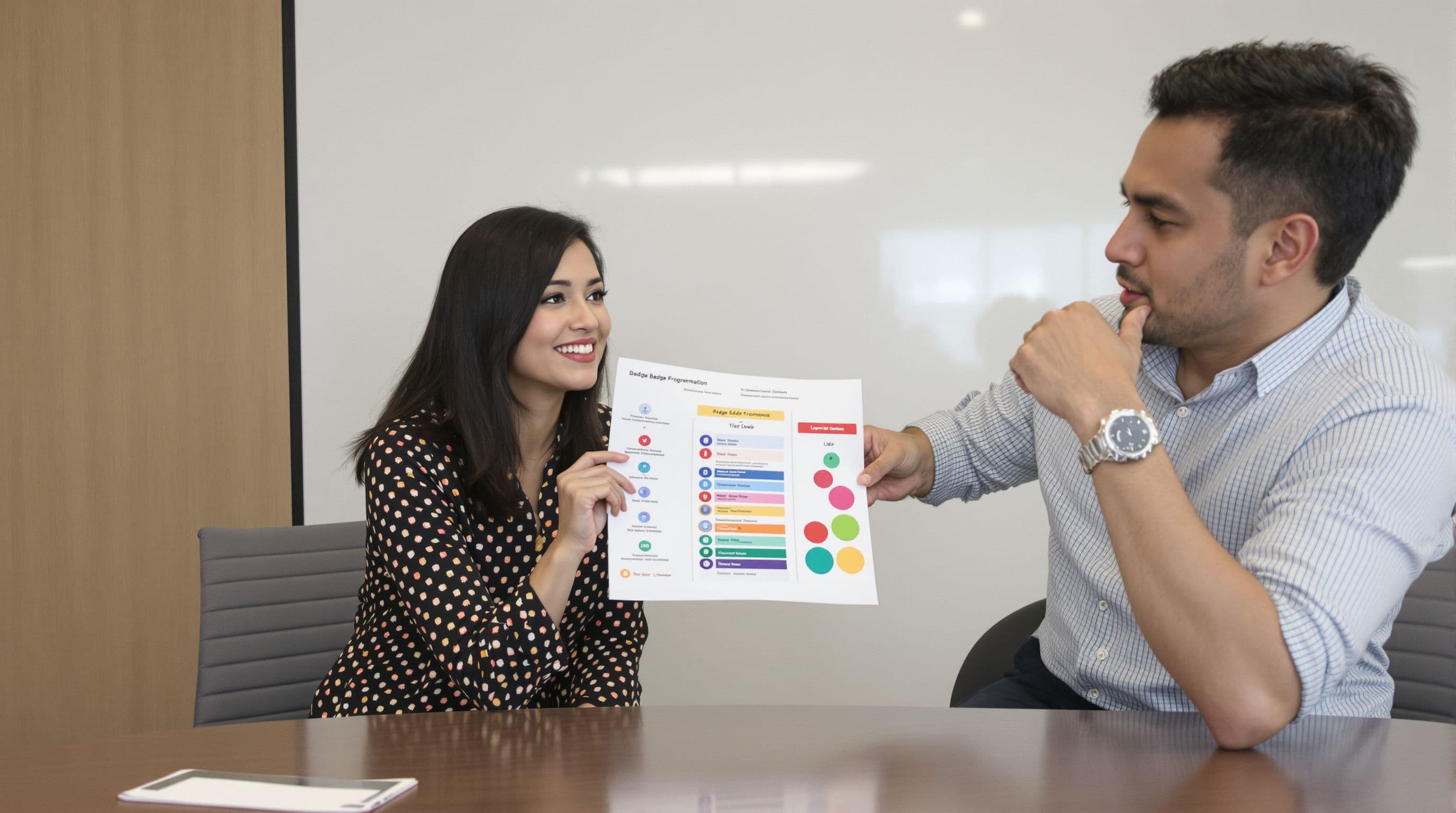
Complement external AI certifications with internal badging programs tailored to your organization's tools, policies, and culture. A practical guide to designing and implementing internal credentials.
Article

A comprehensive framework for assessing and measuring AI skills across your organization. Learn how to evaluate AI competency, identify skill gaps, and build a culture of continuous AI learning.
Article

This guide provides comprehensive frameworks for designing corporate AI training programs that drive measurable business impact through strategic needs...
Article

Measure the effectiveness of AI training programs through comprehensive post-training evaluation. Learn how to assess knowledge transfer, skill application, and behavior change.
THE LANDSCAPE
Talent management software platforms serve as the backbone of modern HR operations, providing integrated technology solutions for performance management, succession planning, learning management, and employee development. As organizations face intensifying competition for skilled workers and rising costs associated with employee turnover, these platforms must evolve beyond basic tracking systems to deliver predictive insights and personalized experiences at scale.
AI transforms talent management through predictive turnover modeling that identifies flight risks 6-9 months in advance, personalized learning recommendations that adapt to individual career trajectories and skill gaps, automated performance review analysis that surfaces coaching opportunities and eliminates recency bias, and succession planning algorithms that match organizational needs with employee capabilities and aspirations. Natural language processing analyzes employee feedback and sentiment across surveys, performance conversations, and internal communications to detect engagement trends. Machine learning models identify the competencies and career paths of top performers, enabling data-driven talent development strategies.
DEEP DIVE
HR technology companies face persistent challenges including fragmented data across legacy systems, low manager adoption of time-intensive processes, inability to demonstrate ROI on learning investments, and succession plans based on subjective assessments rather than objective readiness metrics. Organizations implementing AI-enhanced talent management systems report employee retention improvements of 40%, engagement score increases of 55%, and succession planning accuracy gains of 70%. Digital transformation opportunities include integrating skills inference engines that auto-populate employee profiles, deploying chatbots for personalized career guidance, and building competency marketplaces that match internal talent to projects and roles.
1. Manager collects feedback from 5-10 people (1 week wait) 2. Manually reads all feedback (1 hour) 3. Identifies common themes and patterns (30 min) 4. Writes performance summary (1 hour) 5. Creates development plan (30 min) 6. Reviews and edits (30 min) Total time: 3.5 hours + 1 week collection time
1. AI automatically collects feedback via surveys 2. AI analyzes all feedback for themes 3. AI identifies strengths and development areas 4. AI generates draft performance summary 5. AI suggests development plan actions 6. Manager reviews, personalizes, finalizes (30 min) Total time: 30-45 minutes + automatic collection
Risk of over-generalizing feedback nuance. May miss important context from individual comments. Sensitive handling of negative feedback required.
Our team has trained executives at globally-recognized brands


YOUR PATH FORWARD
Every AI transformation is different, but the journey follows a proven sequence. Start where you are. Scale when you're ready.
ASSESS · 2-3 days
Understand exactly where you stand and where the biggest opportunities are. We map your AI maturity across strategy, data, technology, and culture, then hand you a prioritized action plan.
Get your AI Maturity ScorecardChoose your path
TRAIN · 1 day minimum
Upskill your leadership and teams so AI adoption sticks. Hands-on programs tailored to your industry, with measurable proficiency gains.
Explore training programsPROVE · 30 days
Deploy a working AI solution on a real business problem and measure actual results. Low risk, high signal. The fastest way to build internal conviction.
Launch a pilotSCALE · 1-6 months
Roll out what works across the organization with governance, change management, and measurable ROI. We embed with your team so capability transfers, not just deliverables.
Design your rolloutITERATE & ACCELERATE · Ongoing
AI moves fast. Regular reassessment ensures you stay ahead, not behind. We help you iterate, optimize, and capture new opportunities as the technology landscape shifts.
Plan your next phaseLet's discuss how we can help you achieve your AI transformation goals.
