AI assistant handles meeting scheduling, finds optimal times across attendees, sends invites, and manages rescheduling. Works with email and calendar systems. Intelligent calendar orchestration transcends rudimentary time-slot matching by incorporating preference learning algorithms that internalize individual scheduling idiosyncrasies—meeting-free morning blocks for deep concentration work, buffer intervals between consecutive external engagements, travel time padding calibrated to geographic distances between consecutive venue locations, and circadian productivity rhythm alignment that positions cognitively demanding sessions during personal peak performance windows. Multi-participant availability optimization solves combinatorial scheduling constraints across distributed team calendars, timezone boundaries, and meeting room resource allocation simultaneously. Constraint satisfaction solvers evaluate thousands of potential time-slot configurations, weighting factors including participant priority rankings, meeting urgency [classifications](/glossary/classification), preparation time requirements, and organizational hierarchy considerations that prioritize executive calendar availability over junior staff flexibility. Predictive rescheduling anticipates disruption cascades when upstream meetings overrun allocated durations or participants encounter travel delays. Calendar telemetry data—historical meeting end-time distributions per recurring event type, traffic congestion probability models for in-person appointments—enables proactive schedule adjustment recommendations pushed to affected participants before conflicts materialize. External stakeholder scheduling eliminates email ping-pong through intelligent booking link generation that exposes curated availability windows filtered by meeting type, participant count, and requestor relationship tier. VIP clients receive expanded availability access while unsolicited meeting requests route through gatekeeping workflows requiring purpose justification before calendar time allocation. CRM integration auto-populates meeting context cards with relationship history, outstanding proposal status, and preparation notes. Resource co-scheduling coordinates meeting room assignments, video conferencing bridge provisioning, catering orders, and equipment reservations as atomic operations ensuring all logistical dependencies satisfy simultaneously. Room occupancy sensors provide real-time utilization data feeding capacity optimization algorithms that identify chronically underutilized premium spaces suitable for reallocation and oversubscribed standard rooms requiring expansion investment. Timezone intelligence handles the cognitive complexity of global scheduling, presenting proposed times in each participant's local timezone with ambient context annotations—"Tuesday 9:00 AM your time (Wednesday 1:00 AM Tokyo)"—preventing the confusion that plagues manual coordination across international date line boundaries. Daylight saving time transition awareness automatically adjusts recurring meeting series when participating regions shift clock offsets on different calendar dates. Meeting cadence optimization analyzes organizational scheduling patterns to recommend reduced meeting frequencies, shortened default durations, or asynchronous alternatives for recurring gatherings demonstrating declining attendance or minimal agenda substance. Fragmentated calendar analysis quantifies available focus time blocks, alerting managers when direct reports' schedules become excessively fragmented by meetings, undermining productive output capacity. Natural language scheduling interfaces accept conversational requests—"find thirty minutes with the marketing team next week, preferably afternoon"—translating informal specifications into precise constraint parameters driving optimization algorithms. [Voice assistant](/glossary/voice-assistant) integration enables hands-free scheduling during commutes, leveraging [speech recognition](/glossary/speech-recognition) and calendar API orchestration to confirm appointments without screen interaction. Analytics dashboards present scheduling efficiency metrics including average time-to-confirmation for meeting requests, calendar utilization ratios by organizational unit, meeting density distributions across workweek periods, and no-show frequency patterns enabling behavioral intervention for chronically absent participants. Integration with project management platforms synchronizes milestone review meetings, sprint ceremonies, and stakeholder checkpoint schedules with delivery timeline dependencies, ensuring governance cadences adapt dynamically when project schedules shift rather than persisting as orphaned calendar obligations disconnected from current delivery realities. Travel-time buffer injection queries Google Maps Distance Matrix API with departure-time-aware traffic prediction, inserting transit duration padding between consecutive off-site appointments that accounts for metropolitan congestion probability distributions, parking structure availability heuristics, and pedestrian wayfinding intervals from vehicle egress to destination lobby reception. Timezone-aware availability negotiation resolves scheduling conflicts across distributed team members spanning non-contiguous UTC offset zones, applying daylight saving transition awareness that prevents phantom availability gaps during spring-forward clock advancement and duplicate slot offerings during fall-back hour repetition periods.
1. Assistant receives meeting request via email/message 2. Checks executive's calendar for availability (5 min) 3. Emails attendees with 3-4 time options (5 min) 4. Waits for responses (1-2 days, multiple rounds) 5. Books confirmed time, sends calendar invites (5 min) 6. Handles conflicts and rescheduling (10 min per change) Total time: 25+ minutes per meeting + 1-2 days latency
1. Meeting request received 2. AI checks all attendees' calendars instantly 3. AI finds optimal time considering preferences, time zones 4. AI sends calendar invites automatically 5. AI handles confirmations and conflicts 6. AI reschedules if needed with notifications Total time: < 1 minute per meeting, same-day booking
Risk of scheduling conflicts if calendar access incomplete. May not account for soft preferences or informal commitments.
Require calendar access permissions from all attendeesAllow manual override and preferencesFlag unusual scheduling patterns for reviewRespect do-not-schedule blocks
Implementation typically costs $15,000-50,000 depending on firm size and integration complexity, with deployment taking 6-12 weeks. Most consulting firms see full ROI within 8-10 months through reduced administrative overhead and improved billable hour utilization.
You'll need existing calendar systems (Outlook, Google Workspace) and email infrastructure with API access enabled. The AI requires integration with your CRM system and client databases to understand meeting priorities and attendee hierarchies common in consulting engagements.
The AI learns client priority levels, partner availability preferences, and project urgency to optimize scheduling decisions. It can automatically escalate conflicts involving senior stakeholders and respects consulting-specific constraints like client site visits and travel schedules.
Key risks include scheduling conflicts with high-priority clients due to AI misunderstanding context, and potential data privacy concerns when handling client calendar information. Mitigation requires proper training data, approval workflows for critical meetings, and robust data encryption protocols.
Track administrative time savings (typically 60-80% reduction in scheduling back-and-forth), increased billable hour utilization, and reduced meeting conflicts. Most consulting firms also measure client satisfaction improvements and consultant productivity gains from eliminating scheduling friction.
Explore articles and research about implementing this use case
Article

A guide to AI training for Indonesian professional services firms, covering practical applications in law, accounting and consulting, including Bahasa Indonesia document processing and regulatory compliance.
Article

AI training for Singapore law firms, accounting practices, and consulting firms. Contract analysis, due diligence automation, and SkillsFuture subsidised workshops for professional services teams.
Article

AI training for law firms, accounting practices, and consulting firms in Malaysia. HRDF claimable programmes covering contract review, audit automation, proposal generation, and research workflows.
Article
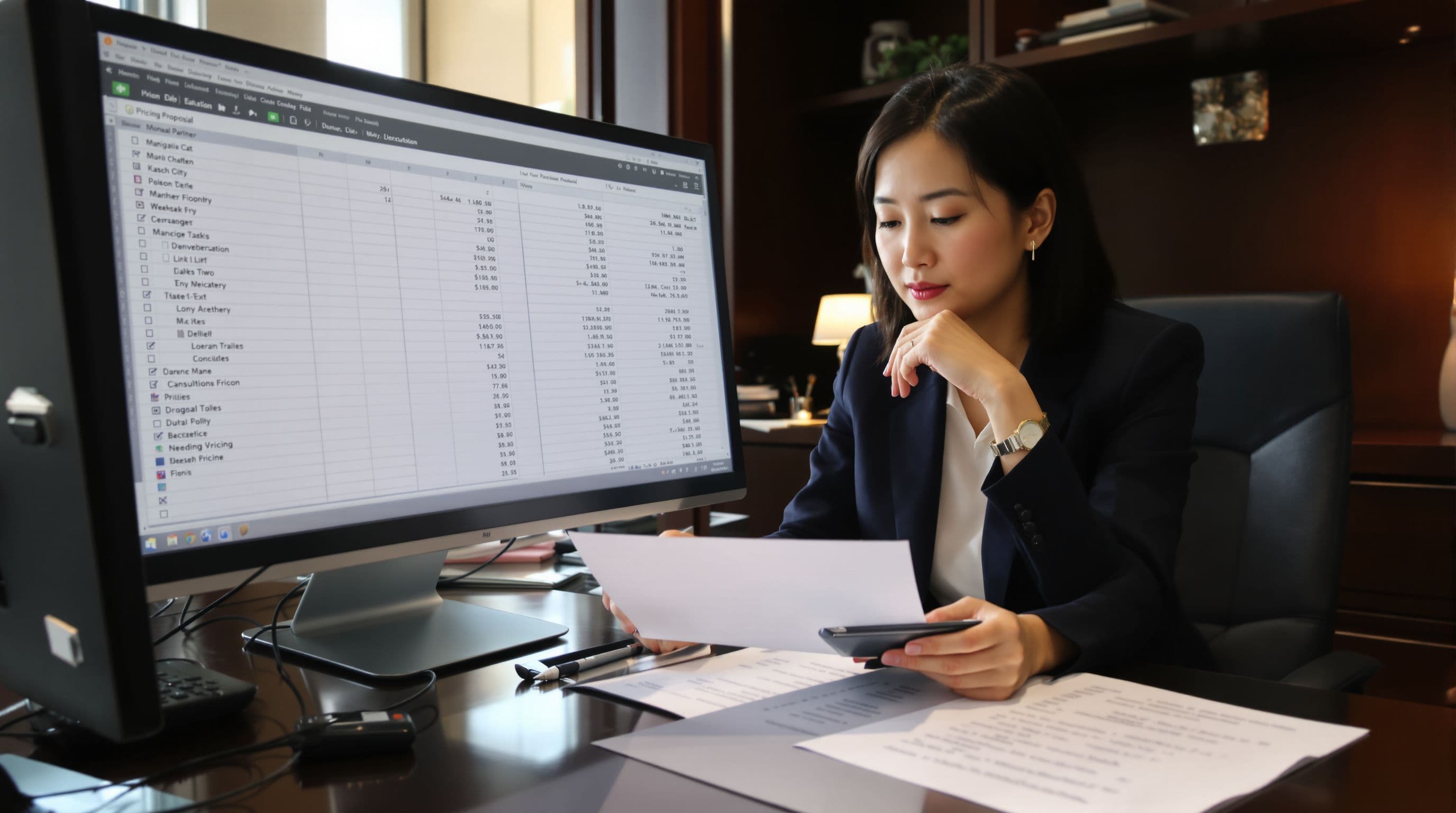
This comprehensive guide breaks down AI consulting pricing across all service models, from hourly strategy sessions to full transformation programs, with...
THE LANDSCAPE
Management consulting firms advise organizations on strategy, operations, digital transformation, and organizational change across industries. The global management consulting market exceeds $300 billion annually, with firms ranging from Big Four advisory practices to specialized boutique consultancies. AI accelerates market research, automates data analysis, generates strategic insights, and optimizes project delivery. Consulting firms using AI improve project margins by 35%, reduce research time by 65%, and increase consultant productivity by 50%.
Key technologies transforming the sector include natural language processing for document analysis, predictive analytics for forecasting, generative AI for proposal creation, and machine learning for pattern recognition across client data. Revenue models center on billable hours, retainer agreements, and value-based pricing tied to outcomes.
DEEP DIVE
Critical pain points include high overhead from manual research, inconsistent knowledge sharing across projects, difficulty scaling expertise, and pressure on margins from commoditization of routine analysis. Junior consultants spend 40-60% of time on repetitive data gathering rather than strategic work.
1. Assistant receives meeting request via email/message 2. Checks executive's calendar for availability (5 min) 3. Emails attendees with 3-4 time options (5 min) 4. Waits for responses (1-2 days, multiple rounds) 5. Books confirmed time, sends calendar invites (5 min) 6. Handles conflicts and rescheduling (10 min per change) Total time: 25+ minutes per meeting + 1-2 days latency
1. Meeting request received 2. AI checks all attendees' calendars instantly 3. AI finds optimal time considering preferences, time zones 4. AI sends calendar invites automatically 5. AI handles confirmations and conflicts 6. AI reschedules if needed with notifications Total time: < 1 minute per meeting, same-day booking
Risk of scheduling conflicts if calendar access incomplete. May not account for soft preferences or informal commitments.
Our team has trained executives at globally-recognized brands


YOUR PATH FORWARD
Every AI transformation is different, but the journey follows a proven sequence. Start where you are. Scale when you're ready.
ASSESS · 2-3 days
Understand exactly where you stand and where the biggest opportunities are. We map your AI maturity across strategy, data, technology, and culture, then hand you a prioritized action plan.
Get your AI Maturity ScorecardChoose your path
TRAIN · 1 day minimum
Upskill your leadership and teams so AI adoption sticks. Hands-on programs tailored to your industry, with measurable proficiency gains.
Explore training programsPROVE · 30 days
Deploy a working AI solution on a real business problem and measure actual results. Low risk, high signal. The fastest way to build internal conviction.
Launch a pilotSCALE · 1-6 months
Roll out what works across the organization with governance, change management, and measurable ROI. We embed with your team so capability transfers, not just deliverables.
Design your rolloutITERATE & ACCELERATE · Ongoing
AI moves fast. Regular reassessment ensures you stay ahead, not behind. We help you iterate, optimize, and capture new opportunities as the technology landscape shifts.
Plan your next phaseLet's discuss how we can help you achieve your AI transformation goals.
