ChatGPT
 Google AI
 Claude
 Perplexity
 Grok
Grok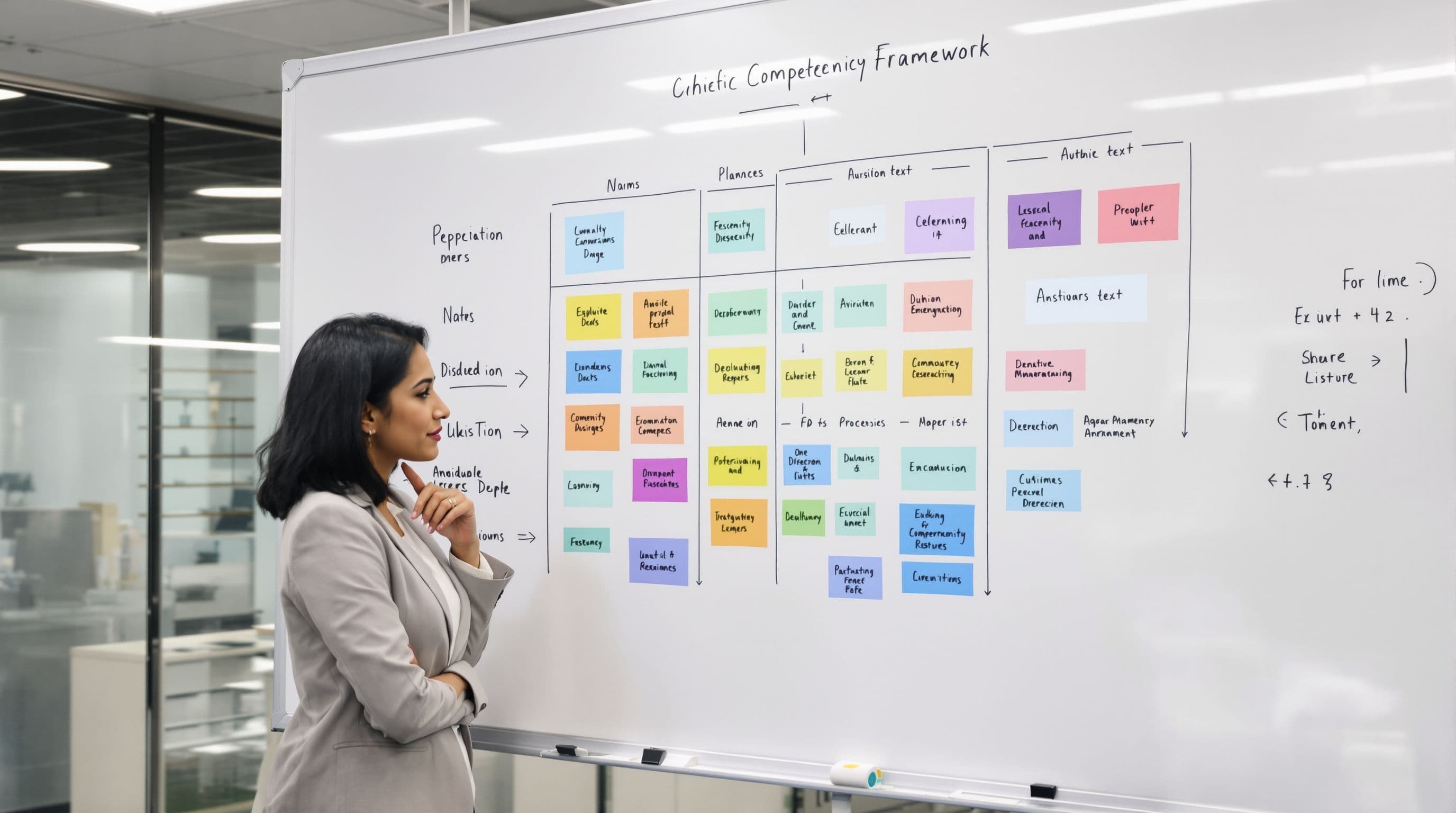
Most organizations today acknowledge that AI capabilities matter. Far fewer have defined what "AI capable" actually means for the roles within their workforce. The result is a familiar pattern: pockets of experimentation without coherence, training investments untethered from strategic priorities, and hiring managers left to interpret "AI-savvy" however they see fit. A well-designed AI competency framework resolves this ambiguity by translating organizational AI ambitions into specific, measurable expectations for every position.
The stakes are significant. According to McKinsey's The State of AI in early 2024, 72% of organizations have adopted AI in at least one business function, yet only a fraction report having the internal talent to scale those initiatives. The gap between adoption and capability is where competency frameworks do their most important work.
What Is an AI Competency Framework?
An AI competency framework is a structured model that defines the AI-related skills and knowledge required across an organization, organizes those competencies into logical categories and progression levels, maps them to specific roles, establishes assessment criteria for measuring attainment, and clarifies learning paths for development.
In practical terms, it replaces vague aspirations with a common language. Rather than asking whether a marketing analyst "understands AI," a framework specifies that she can craft multi-step prompts using chain-of-thought techniques, evaluate outputs against source data for accuracy, and identify when a use case falls outside acceptable risk parameters. That precision changes everything downstream, from how the organization hires to how it measures return on training investment.
Why Your Organization Needs an AI Competency Framework
Strategic Value
The most immediate benefit is alignment. When competency requirements are explicit, leadership can map AI investment directly to capability gaps rather than relying on intuition about where training dollars should flow. Hiring decisions become more defensible because job descriptions reference observable skills rather than buzzwords. Succession planning improves because the framework identifies which competencies will matter in future roles, not just current ones.
The World Economic Forum's Future of Jobs Report 2025 projects that 59% of the global workforce will need training by 2030, with AI and big data ranking among the most critical emerging skill sets. A competency framework provides the structure to pursue that reskilling systematically rather than reactively.
Operational Consistency
Without a framework, departments inevitably develop their own definitions of AI proficiency. Finance interprets it through the lens of forecasting models. Marketing focuses on generative content tools. Customer service emphasizes chatbot management. Each definition may be valid, but the lack of shared vocabulary makes it nearly impossible to benchmark talent across the organization, identify transferable skills, or build training programs that serve more than one team.
A competency framework standardizes assessment, reduces redundancy in training design, and enables internal mobility by making clear which skills carry from one function to another.
Employee Clarity
From an individual contributor's perspective, the framework answers the question that AI adoption so often leaves unanswered: what exactly am I expected to learn, and how will I know when I have learned it? In our experience, employees engage more readily when they understand how their role is evolving and what is expected of them. Competency frameworks provide that clarity through defined expectations, visible progression paths, and recognition mechanisms tied to demonstrated capability rather than tenure.
Core Components of an AI Competency Framework
Competency Domains
Every framework begins with high-level domains that organize related skills into coherent categories. Five domains tend to appear across industries, though their relative emphasis varies by organizational context.
AI Fundamentals covers the conceptual foundation: understanding AI terminology, recognizing the capabilities and limitations of different AI types (generative, predictive, and automation-focused), and developing sufficient technical literacy to participate meaningfully in decisions about AI adoption.
AI Application addresses practical proficiency. This includes the use of AI tools and platforms, prompt engineering and interaction techniques, and the integration of AI into existing workflows to improve productivity.
AI Evaluation focuses on the critical judgment that separates effective AI users from passive ones. It encompasses the assessment of AI outputs for quality and accuracy, fact-checking and verification practices, and the ability to measure and improve AI-assisted performance over time.
AI Governance captures the risk and compliance dimension: identifying and mitigating AI-related risks, adhering to organizational policies and ethical guidelines, and maintaining data privacy and security standards.
AI Leadership is the strategic layer, relevant primarily for managers and senior contributors. It includes the ability to identify and prioritize AI use cases, lead change management and adoption efforts, and integrate AI considerations into strategic planning.
The right framework emphasizes the domains most critical to the organization's strategy and risk profile. A financial services firm will weight governance far more heavily than a creative agency, which may place greater emphasis on application and evaluation.
Proficiency Levels
Within each domain, a progression model defines what competency looks like at different stages of development. A five-level model provides sufficient granularity without becoming unwieldy.
At Level 1 (Foundational), an individual demonstrates basic awareness and can recognize and describe key concepts, though significant guidance is still required. At Level 2 (Developing), working knowledge begins to emerge, and the individual can apply skills with occasional support. Level 3 (Proficient) represents solid, independent capability, including the ability to troubleshoot issues and guide others informally. Level 4 (Advanced) indicates deep expertise, the capacity to handle complex and exceptional scenarios, and the ability to formally train and mentor colleagues. At Level 5 (Expert), the individual exercises thought leadership, shapes organizational strategy, and is recognized as an authority both internally and externally.
A critical design principle: not every role requires Level 5 proficiency. For the majority of knowledge workers, Level 2 to 3 represents the practical target. Setting expectations higher than the role demands creates frustration without generating proportional value.
Competency Statements
The granular building blocks of any framework are competency statements, which describe specific, observable behaviors. The difference between a useful statement and a useless one is precision.
A statement like "understands AI" provides no assessment guidance whatsoever. "Explains how large language models generate text" is better because it names a specific capability. The strongest version goes further: "Explains how large language models generate text, including the role of training data, parameters, and probabilistic selection, and describes implications for output quality." This level of specificity makes assessment consistent and development targeted.
Effective competency statements share several characteristics. They are specific about what the person can do, observable through demonstration or evaluation, measurable against objective criteria, action-oriented (beginning with verbs such as "explain," "create," "evaluate," or "implement"), and scaled to the appropriate proficiency level.
Build the leadership discipline that the 20% share
Sustained executive sponsorship and clear success metrics are what separate AI success from failure. Our executive AI programs build both.
Explore executive AI trainingRole Profiles
Role profiles bring domains, levels, and competency statements together by defining the combination of competencies required for a specific position.
Consider the difference in profiles across three common roles. A customer service representative operating in a tool-intensive environment might target Level 2 across most domains but Level 3 in AI Application, reflecting the hands-on nature of the work. A data analyst would require higher proficiency overall, particularly Level 4 in both Application and Evaluation, where advanced tool use and critical output assessment are central to job performance. A department manager, by contrast, might need only Level 2 in Application (enough to use tools competently) but Level 4 in Leadership, where the ability to identify use cases, drive adoption, and make strategic decisions is the key differentiator.
These profiles guide hiring criteria, shape individual development plans, and set the foundation for performance conversations grounded in observable capability rather than subjective impressions.
Building Your AI Competency Framework
Step 1: Define Framework Scope
Before drafting a single competency, the organization must answer three scoping questions.
Breadth: which roles and functions does the framework cover? The choice between all employees and a targeted subset (such as frequent AI tool users or a specific department) determines the framework's complexity and the resources required for implementation.
Depth: how granular should competencies be? Some organizations need only high-level domain definitions. Others require tool-specific capabilities mapped to individual applications in their technology stack.
Horizon: what timeframe governs the design? A framework built solely around current AI capabilities will need revision within months. One that accounts for a one-to-two-year roadmap, with provisions for longer-term evolution, will prove more durable.
The most successful implementations start narrow and expand. A focused framework covering the twenty most AI-exposed roles will generate adoption and learning far faster than a comprehensive framework spanning every position in the organization that never quite reaches deployment.
Step 2: Identify Core Competencies
Competency identification draws on three categories of input. Internal analysis examines current AI tool requirements, incident reports and support tickets that reveal capability gaps, behaviors observed in high performers, and manager assessments of team needs. External research surveys industry frameworks, professional certifications and standards, academic AI literacy research, and competitor job postings. Stakeholder input captures employee perspectives through focus groups and surveys, leadership priorities, IT and security requirements, and compliance mandates.
Synthesis of these inputs typically yields an initial list of 20 to 40 competencies organized across four to six domains. This range is large enough to be meaningful and small enough to be manageable.
Step 3: Define Proficiency Levels
For each competency, the framework must describe what each proficiency level looks like in practice. Consider prompt engineering as an illustration.
At the Foundational level, an individual understands that prompt phrasing affects output quality and can follow provided templates with minor modifications. At the Developing level, the individual writes clear and specific prompts for common tasks, iterates based on results, and applies basic techniques such as role assignment and example provision. At the Proficient level, the individual crafts sophisticated prompts using advanced techniques (chain-of-thought reasoning, few-shot learning, and explicit constraints), optimizes for efficiency and consistency, and creates reusable templates for the team. At the Advanced level, the individual develops prompt strategies for complex multi-step tasks, evaluates and selects optimal patterns for different scenarios, and trains others. At the Expert level, the individual researches and implements cutting-edge methods, develops organizational standards, and contributes to external knowledge through writing or speaking.
This granularity enables precise assessment. It also makes clear that the distance between each level is not merely incremental but qualitatively different, involving new types of thinking and responsibility at each stage.
Step 4: Create Role Profiles
Mapping competencies to positions is a five-step process. The organization first lists all roles in scope (or, for larger enterprises, role families that group similar positions). It then identifies the critical competencies for each role, sets target proficiency levels for both minimum acceptability and aspirational development, validates profiles with managers and current role holders, and documents the rationale for key decisions.
Prioritization matters here. Roles with high AI exposure or significant risk impact should receive profile development first, as they represent both the greatest opportunity and the greatest vulnerability.
Step 5: Develop Assessment Methods
Different competency types call for different measurement approaches. Knowledge-based competencies lend themselves to tests, quizzes, and certifications. Skill-based competencies require practical demonstrations and work samples that show the individual applying the capability in realistic contexts. Behavioral competencies, such as ethical judgment or change leadership, are best assessed through observation, 360-degree feedback, and manager evaluations.
Regardless of method, specifying assessment criteria and scoring rubrics in advance is essential for consistency. Without them, the same competency will be evaluated differently by different assessors, undermining the framework's credibility.
Step 6: Pilot and Refine
No framework should move to full deployment without a pilot. Testing with a representative sample of roles and employees answers the questions that design alone cannot: Does the framework accurately reflect actual skill requirements? Can competencies be reliably and consistently assessed? Is the language clear and unambiguous? Are proficiency levels appropriately differentiated? Do role profiles match the reality of how work is performed?
Iteration based on pilot feedback is not a sign of weak design. It is the mechanism by which the framework earns organizational trust.
Framework Implementation Strategies
Phased Rollout
The most effective implementations proceed in phases. The first phase covers core roles with high AI exposure, establishing proof of value and generating early lessons. The second phase extends to supporting roles and adjacent functions. The third phase reaches the remaining population, and the fourth addresses specialized or emerging roles that may require unique competency definitions.
This sequencing allows the organization to learn and refine at each stage rather than committing to a single, untested design across the entire workforce simultaneously.
Integration Points
A competency framework delivers its full value only when embedded across the talent management lifecycle. In recruiting, it shapes job descriptions, interview guides, and candidate evaluation criteria. During onboarding, it establishes AI capability expectations, triggers initial assessments, and directs foundational training. For ongoing development, it informs individual development plans and learning path recommendations. In performance management, it provides goal-setting benchmarks, evaluation criteria, and a structured basis for feedback conversations. In succession planning, it enables readiness assessment and high-potential identification. And in compensation, it supports skill-based pay considerations and certification incentives.
A framework that exists in isolation from these systems, however well designed, will not drive behavior change.
Communication and Adoption
Adoption requires intentional effort. A launch campaign should introduce the framework and its benefits in terms employees care about, particularly career clarity and development support. Manager enablement is critical because managers are the primary channel through which the framework reaches daily practice. Employee resources should explain competencies and progression in accessible language. Success stories showcasing framework-driven growth build credibility. And regular updates signal that the framework is a living system, not a one-time initiative that will quietly fade.
Customizing for Different Organizational Contexts
By Industry
Industry context shapes which domains and competencies receive the greatest weight. In healthcare, clinical judgment, patient privacy, and bias awareness deserve particular emphasis. Financial services organizations will prioritize risk management, regulatory compliance, and auditability. Education settings should highlight pedagogical applications and student data protection. Manufacturing environments will stress operational AI, automation integration, and safety considerations.
By Organization Size
Size influences framework complexity. Organizations with fewer than 100 employees benefit from a simplified framework with combined role profiles and a foundational focus. Mid-sized organizations (100 to 1,000 employees) can support a standard framework with role families and some specialization. Large enterprises with more than 1,000 employees typically require comprehensive frameworks with granular role definitions and advanced progression paths.
By AI Maturity
An organization's current position on the AI maturity curve determines where the framework should place its initial emphasis. Organizations in the early stages of adoption should focus on foundational competencies, awareness building, and risk literacy. Those in a developing phase should emphasize practical application, workflow integration, and growing sophistication. Advanced organizations can invest in specialized competencies, innovation capabilities, and strategic AI leadership.
Maintaining and Evolving Your Framework
An AI competency framework is not a document to be written once and filed. The pace of AI development makes ongoing maintenance essential.
Review Cadence
In our experience, organizations should revisit AI skill definitions at least quarterly for minor updates reflecting new tools or techniques, annually for major reviews of competency structures and proficiency levels, and on an as-needed basis when significant AI developments or organizational changes demand immediate attention.
Triggers for Update
Several signals indicate that a framework revision is overdue: the introduction of new AI tools or capabilities that existing competencies do not address, emerging risks or compliance requirements, assessment data revealing systematic gaps or misalignments between framework expectations and observed performance, consistent feedback from employees or managers that certain competencies are unclear or irrelevant, and evolution in industry standards or professional certification requirements.
Governance Structure
Sustaining a framework requires clear ownership. A framework owner maintains overall integrity and strategic direction. An advisory group provides ongoing input on priorities and updates. Subject matter expert reviewers validate technical accuracy and practical relevance. Stakeholder approvers endorse major changes before they take effect. Without this governance structure, frameworks tend to drift into obsolescence within 12 to 18 months.
Common Framework Pitfalls
Six failure modes appear with particular frequency, and each is avoidable with deliberate design choices.
Over-complexity is the most common. Frameworks with more than 100 competencies across 10 or more domains overwhelm the users they are meant to serve. A focused, navigable framework that employees actually consult will outperform an exhaustive one that sits unused.
Under-specificity is the opposite problem. Competencies framed as vaguely as "uses AI effectively" provide no guidance for assessment or development. Precision is the entire point.
Technical bias emerges when framework designers overweight coding and data science skills at the expense of critical non-technical competencies such as ethical reasoning, output judgment, and change leadership. For most roles, these non-technical capabilities matter more than technical depth.
Static design reflects a failure to build review and update mechanisms into the framework from the outset. Given the pace of AI evolution, a framework without a maintenance plan is a framework with a short shelf life.
Poor integration occurs when the framework exists as a standalone artifact rather than an embedded element of recruiting, onboarding, performance management, and development systems. Frameworks that do not touch daily talent practices do not change behavior.
Unrealistic expectations arise when proficiency targets exceed what the role actually requires. Setting Level 4 or 5 expectations for positions that need Level 2 capability generates frustration, undermines credibility, and wastes training resources.
Measuring Framework Effectiveness
A deployed framework requires measurement across three dimensions.
Adoption metrics track whether the framework is actually being used: its presence in job descriptions, individual development plans, and performance reviews; manager and employee familiarity with its structure; and alignment between assessment practices and framework competencies.
Quality metrics assess whether the framework works as designed: inter-rater reliability on competency assessments (do different evaluators reach the same conclusions?), stakeholder satisfaction with clarity and relevance, and the framework's ability to differentiate meaningfully between performance levels.
Outcome metrics connect the framework to business results: improved hiring quality measured by skill match to role requirements, faster onboarding and time-to-productivity when new AI tools are introduced, higher training ROI through targeted rather than generic development, reduced AI-related incidents and compliance issues, and stronger correlation between assessed competency levels and actual job performance.
These metrics close the loop, ensuring that the framework evolves based on evidence rather than assumption.
Conclusion
An AI competency framework transforms ambiguous expectations into a clear, actionable system for building organizational capability. It provides the shared language, assessment rigor, and development structure that ad hoc approaches cannot deliver.
Building an effective framework demands careful scoping, stakeholder engagement, iterative validation, and a genuine commitment to ongoing evolution. The right approach is to start with core roles and high-priority competencies, validate through piloting, and expand systematically as the organization's AI maturity grows.
The organizations that invest in this work now will compound their advantage over time. Every quarter of structured capability building widens the gap between companies whose workforces can deploy AI strategically and those still debating what "AI-savvy" means.
Common Questions
Aim for 20-40 competencies across 4-6 domains for most organizations. Fewer than 15 lacks specificity; more than 50 becomes unwieldy. Start with core competencies covering fundamentals, application, evaluation, and governance, then expand based on organizational needs and AI maturity.
Balance both. Core competencies should be tool-agnostic (prompt engineering, critical evaluation, risk awareness) to remain relevant as tools change. Add tool-specific competencies for strategic platforms with significant organizational investment. Consider tool-specific competencies as sub-categories within broader skill domains.
Build foundational competencies that prepare for future roles. Focus on transferable skills like AI literacy, adaptability, and learning agility. Create "emerging role" profiles based on industry trends and strategic plans. Update framework as roles materialize. This forward-looking approach ensures workforce readiness for AI evolution.
Yes, leverage industry frameworks, certification standards, and academic research as foundation. However, customize significantly to reflect your organization's specific tools, risks, culture, and strategic priorities. What works for a tech company differs from healthcare or education. Use external frameworks as templates, not prescriptions.
Analyze work requirements: what competencies are actually needed for successful job performance? Survey high performers to understand their capabilities. Start with lower expectations and raise as organizational maturity grows. Remember that Level 2-3 proficiency is sufficient for most roles; reserve Level 4-5 for specialists and leaders.
References
- The State of AI in early 2024: Gen AI adoption spikes and starts to generate value. McKinsey & Company (2024). View source
- The Future of Jobs Report 2025. World Economic Forum (2025). View source