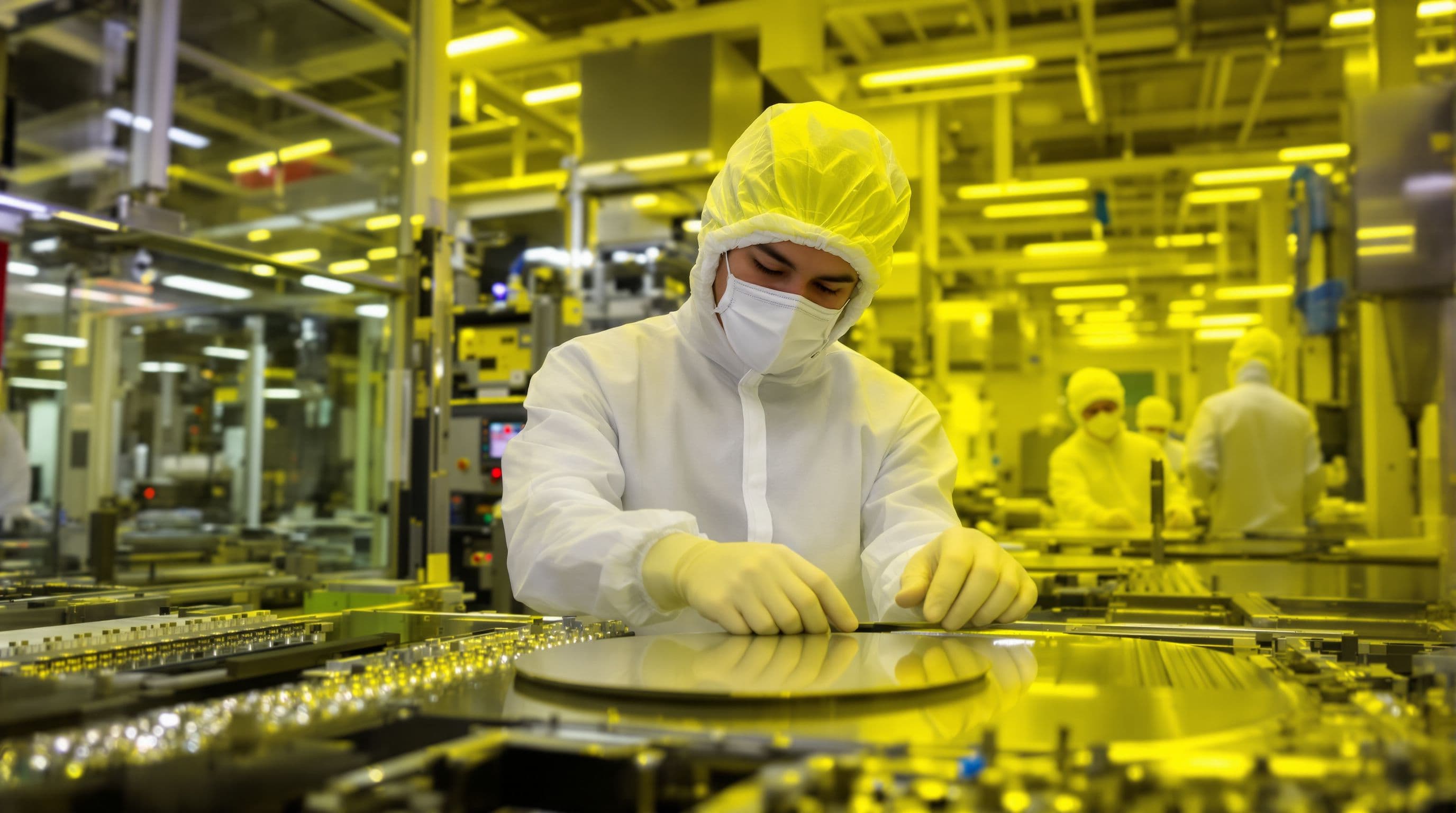
Manufacturing
We help electronics and semiconductor companies deploy AI across fabrication yield optimization, design automation, supply chain resilience, and test engineering to accelerate innovation cycles and improve manufacturing competitiveness.
CHALLENGES WE SEE
Microscopic defects in semiconductor wafers go undetected until late-stage testing, causing costly production losses and yield degradation.
Supply chain disruptions for rare materials and components create unpredictable delays, forcing production shutdowns and missed delivery commitments.
Manual quality inspection processes are too slow to keep pace with high-volume manufacturing lines, creating bottlenecks and inconsistent defect detection.
Optimizing chip design parameters requires thousands of simulation iterations, consuming months of engineering time and delaying product launches.
Predictive maintenance for complex fabrication equipment is inadequate, leading to unexpected downtime that costs hundreds of thousands per hour.
Tracing root causes of yield losses across multi-step production processes is nearly impossible without real-time data correlation and analysis.
HOW WE CAN HELP
Know exactly where you stand.
Prove AI works for your organization.
Transform how your leadership thinks about AI in 2-3 intensive days.
Turn base AI models into domain experts that know your business.
Forecast demand with 85-95% accuracy and cut supply chain waste.
Detect fraud in real-time and reduce false positives with AI.
THE LANDSCAPE
Electronics and semiconductor companies design, manufacture, and distribute chips, circuit boards, consumer electronics, and components for a global market valued at over $600 billion annually. The sector faces intense competition, razor-thin margins, and unprecedented complexity as chip geometries shrink below 5nm and product lifecycles compress.
AI optimizes chip design, predictive yield management, supply chain planning, and quality control. Companies implementing AI improve chip design efficiency by 40%, increase manufacturing yield by 25%, and reduce time-to-market by 30%. Machine learning models detect microscopic defects invisible to human inspection, predict equipment failures before they occur, and optimize fab operations in real-time.
DEEP DIVE
Key technologies include computer vision for wafer inspection, reinforcement learning for process optimization, digital twins for virtual testing, and predictive analytics for demand forecasting. Leading manufacturers deploy AI-powered electronic design automation (EDA) tools, automated optical inspection systems, and intelligent manufacturing execution systems.
INSIGHTS
Data-driven research and reports relevant to this industry
Southeast Asia's 70+ million small and medium businesses stand at an inflection point in artificial intelligence adoption. The Pertama Partners SEA mid-market AI Adoption Index 2026 — a composite meas
Artificial intelligence is reshaping competitive dynamics across Asia at an unprecedented pace. Asia-Pacific AI spending is projected to reach USD 175 billion by 2028, growing at a 33.6% compound annu
Forrester
Forrester's analysis of AI adoption maturity across Asia Pacific markets including Singapore, Australia, India, Japan, and Southeast Asia. Examines industry-specific adoption rates, barriers to AI imp
NVIDIA
NVIDIA's industry-specific survey on AI adoption in retail and consumer packaged goods. Covers deployment patterns, ROI measurement, use cases in demand forecasting, personalization, supply chain opti
Our team has trained executives at globally-recognized brands


YOUR PATH FORWARD
Every AI transformation is different, but the journey follows a proven sequence. Start where you are. Scale when you're ready.
ASSESS · 2-3 days
Understand exactly where you stand and where the biggest opportunities are. We map your AI maturity across strategy, data, technology, and culture, then hand you a prioritized action plan.
Get your AI Maturity ScorecardChoose your path
TRAIN · 1 day minimum
Upskill your leadership and teams so AI adoption sticks. Hands-on programs tailored to your industry, with measurable proficiency gains.
Explore training programsPROVE · 30 days
Deploy a working AI solution on a real business problem and measure actual results. Low risk, high signal. The fastest way to build internal conviction.
Launch a pilotSCALE · 1-6 months
Roll out what works across the organization with governance, change management, and measurable ROI. We embed with your team so capability transfers, not just deliverables.
Design your rolloutITERATE & ACCELERATE · Ongoing
AI moves fast. Regular reassessment ensures you stay ahead, not behind. We help you iterate, optimize, and capture new opportunities as the technology landscape shifts.
Plan your next phaseAI-powered yield optimization attacks the problem from multiple angles throughout the manufacturing process. Computer vision systems analyze wafer inspection images at resolutions far beyond human capability, detecting nanometer-scale defects, pattern anomalies, and contamination that would otherwise cause chip failures downstream. Machine learning models correlate these defect patterns with thousands of process parameters—temperature variations, chemical concentrations, equipment conditions—to identify root causes that engineers might take weeks to pinpoint manually. The impact is substantial and measurable. Leading semiconductor manufacturers report yield improvements of 15-25% within the first year of AI deployment, with some advanced fabs achieving even higher gains on complex nodes below 7nm. For context, a single percentage point yield improvement on a high-volume production line can translate to millions in additional revenue monthly. Beyond defect detection, reinforcement learning optimizes process recipes in real-time, adjusting parameters like etch time, deposition rates, and lithography exposure to compensate for equipment drift and environmental variations. We typically see the fastest ROI from AI systems that focus on your highest-value, lowest-yield product lines first. A 300mm fab producing 5nm chips might see $10-20 million in annual value from AI-driven yield optimization, primarily through reduced scrap, fewer engineering holds, and faster time-to-stable production. The key is integrating AI with your existing metrology tools and manufacturing execution systems rather than treating it as a standalone solution.
The primary challenge isn't the AI technology itself—it's the data foundation required to make it work effectively. Semiconductor defect detection demands massive volumes of high-quality labeled images, often millions of examples across dozens of defect types. Many manufacturers discover their existing inspection data is fragmented across incompatible systems, inconsistently labeled, or missing critical metadata about process conditions when the defects occurred. Building a training dataset that represents your full range of defect modes, product types, and process variations typically takes 3-6 months of dedicated effort before model development even begins. The second major hurdle is integrating AI systems into production workflows without disrupting existing operations. Fabs operate 24/7 with extremely tight cycle times—introducing an AI inspection system that adds even 30 seconds per wafer can create bottlenecks that cascade through the entire line. We recommend starting with offline analysis of historical data to prove model accuracy, then deploying in parallel with existing inspection methods before fully transitioning to AI-driven decisions. You also need clear escalation protocols for edge cases where the AI confidence is low, because incorrectly scrapping good wafers or passing defective ones both carry significant costs. Finally, there's the expertise gap. Electronics manufacturers need teams that understand both semiconductor physics and machine learning—a rare combination. Your process engineers need to trust the AI's recommendations enough to act on them, which requires explainable models that show why a particular defect was flagged rather than black-box predictions. We've seen successful implementations pair data scientists with veteran fab engineers in joint teams, allowing each to learn from the other while building systems that are both technically sound and operationally practical.
AI addresses supply chain resilience through predictive analytics and scenario planning that human planners simply cannot match at the scale and speed required. The semiconductor supply chain is uniquely complex—chips might pass through 50+ manufacturing steps across multiple continents, with lead times extending 12-26 weeks and demand signals that shift weekly. AI models ingest data from hundreds of sources: customer forecasts, distributor inventory, logistics tracking, geopolitical risk indicators, even satellite imagery of fab construction—then identify supply-demand mismatches months before they become critical shortages. The practical applications deliver measurable value. AI-powered demand forecasting reduces forecast error by 30-50% compared to traditional statistical methods, particularly for newer product lines with limited history. Predictive analytics identify which components are at highest risk of shortage based on single-source dependencies, geopolitical exposure, or supplier financial health, allowing procurement teams to build strategic inventory buffers or qualify alternate sources proactively. During the 2021-2022 chip shortage, manufacturers with mature AI supply chain systems were able to reallocate production capacity and redirect materials 2-3 weeks faster than competitors, translating to significant revenue protection. That said, AI isn't a silver bullet for all supply chain challenges. It cannot manufacture additional capacity when the entire industry is constrained, and it's only as good as the data sharing between supply chain partners. We see the strongest results when companies combine AI forecasting with digital twin simulations that model how disruptions ripple through their specific supply network. This allows you to test 'what-if' scenarios—like a Taiwan fab going offline or a logistics strike—and pre-build response playbooks. The goal isn't perfect prediction; it's reducing response time from weeks to days when disruptions inevitably occur.
Start with a high-impact, narrowly-scoped use case where you already have data infrastructure in place and can measure success objectively. For most electronics manufacturers, automated optical inspection (AOI) for PCB assembly or final product testing is the ideal entry point. You're already capturing images from inspection equipment, you have clear pass/fail criteria, and improving defect detection directly impacts your cost of quality. Many AOI vendors now offer AI-enhanced versions of their systems with pre-trained models that you can fine-tune on your specific products, requiring minimal in-house data science expertise. The beauty of starting with inspection is the rapid feedback loop and clear ROI metrics. You can run the AI system in parallel with your existing inspection process for 4-6 weeks, comparing results to validate accuracy before making any process changes. Target metrics like false positive rate (alerts on good products) and false negative rate (missed defects) give you objective proof points for management. A typical implementation might reduce inspection time by 40% while catching 15-20% more defects than manual inspection, with payback periods of 6-12 months including the system cost. Once you've proven value with inspection, expand to predictive maintenance on your highest-value or most troublesome equipment—pick-and-place machines, reflow ovens, or wire bonders that cause the most unplanned downtime. This builds on your initial success while deepening your team's AI capabilities. We strongly recommend partnering with equipment vendors or specialized AI providers for these first projects rather than building from scratch. You'll move faster, reduce risk, and develop internal knowledge about what good AI implementation looks like before tackling more complex applications like demand forecasting or design optimization that require significant custom development.
AI is fundamentally transforming the front-end design process for semiconductors and complex electronics, addressing what's become an unsustainable scaling challenge. As chips approach 100 billion transistors and system-on-chip designs integrate dozens of IP blocks, traditional EDA workflows require thousands of engineer-hours to optimize placement, routing, power delivery, and timing closure. AI-powered EDA tools use reinforcement learning to explore billions of design alternatives that human engineers couldn't evaluate in reasonable timeframes, often discovering non-intuitive optimizations that improve performance by 10-15% while reducing power consumption. Google's use of AI to design their TPU chip floorplans—completing in hours what would take engineers weeks—demonstrated the technology's potential, and major EDA vendors like Synopsys, Cadence, and Siemens have rapidly integrated similar capabilities into their tools. Beyond layout optimization, AI assists with design verification (predicting which corner cases are most likely to fail), analog circuit design (historically very manual), and even architecture exploration (determining optimal core counts, cache sizes, and interconnect topologies). For companies designing custom ASICs or ASSPs, these tools can compress design cycles by 30-40%, which is critical when product lifecycles have shrunk to 18-24 months. Whether to invest depends on your design complexity and competitive positioning. If you're designing chips below 7nm, high-performance processors, or complex mixed-signal devices, AI-enhanced EDA tools have become table stakes—your competitors are already using them. For simpler designs or companies primarily using off-the-shelf components, the ROI is less compelling. We recommend evaluating based on your engineering bottlenecks: if your team spends significant time on iterative optimization, struggling to close timing on critical paths, or missing market windows due to lengthy design cycles, AI-powered EDA delivers measurable value. Start with vendor trials on a current design to benchmark the actual time savings and performance improvements on your specific products rather than relying on generic claims.
Let's discuss how we can help you achieve your AI transformation goals.


