Secure Government Subsidies and Funding for Your AI Projects
We help you navigate government training subsidies and funding programs (HRDF, SkillsFuture, Prakerja, CEF/ERB, TVET, etc.) to reduce net cost of AI implementations. After securing funding, we route you to Path A (Build Capability) or Path B (Custom Solutions).
Duration
2-4 weeks
Investment
$10,000 - $25,000 (often recovered through subsidy)
Path
c
Vocational and trade schools face unique challenges securing AI funding due to constrained operating budgets, limited access to venture capital, and intense competition for workforce development grants. Unlike traditional higher education institutions, trade schools operate on thin margins with tuition rates that must remain accessible to working-class students, leaving minimal discretionary funds for technology innovation. Federal agencies like the Department of Labor and Department of Education offer substantial grants, but applications require demonstrating measurable outcomes in job placement rates, credential attainment, and employer partnerships—metrics that must be carefully projected for unproven AI initiatives. Additionally, boards and administrators accustomed to funding equipment and facilities often struggle to understand the ROI of AI investments in adaptive learning platforms, skills gap analysis tools, or virtual simulation environments. Funding Advisory specializes in translating AI transformation into the language of workforce outcomes that resonate with both grant reviewers and internal stakeholders. We identify optimal funding pathways including WIOA (Workforce Innovation and Opportunity Act) state grants, Perkins V Career and Technical Education funding, industry-sponsored workforce development initiatives, and philanthropic foundations focused on economic mobility. Our team crafts compelling narratives that connect AI capabilities—such as personalized competency tracking or predictive student support—directly to funder priorities like completion rates, time-to-credential, and labor market alignment. We develop detailed cost-benefit analyses showing how AI reduces instructor burden, increases capacity without facility expansion, and improves employer satisfaction scores. For internal approvals, we facilitate stakeholder workshops that align faculty, administrators, and advisory boards around shared metrics, ensuring your AI funding request addresses concerns about implementation feasibility, faculty adoption, and sustainable operational costs beyond the initial investment.
Department of Labor TAACCCT-style grants ($2-15M, 25-30% success rate): Multi-year funding for AI-powered adaptive learning platforms and competency-based progression systems in high-demand trades like advanced manufacturing, healthcare, and IT.
Perkins V Reserve Fund state allocations ($250K-$2M, 40-45% success rate): Annual formula grants supporting AI tools for labor market alignment, including predictive analytics for program offerings and automated credential pathway mapping.
Corporate workforce partnerships with manufacturers, utilities, and healthcare systems ($100K-$500K, 55-60% success rate): Co-investment arrangements where employers fund AI simulation labs and virtual training environments that reduce their onboarding costs.
Community foundation and workforce development grants ($50K-$300K, 35-40% success rate): Local and regional funding for AI-enhanced student support systems, including chatbots for advising, early alert systems, and job placement matching algorithms.
Funding Advisory helps you navigate Department of Labor competitive grants (historically $2-15M), Perkins V Reserve Funds administered by state agencies, and NSF Advanced Technological Education grants (up to $800K). We identify which AI applications align with each program's priorities—such as using DOL funds for stackable credential systems or Perkins dollars for labor market analytics—and position your proposal to score highest on workforce outcome metrics that reviewers prioritize.
We develop phased ROI models that demonstrate quick wins alongside long-term gains: immediate reductions in administrative hours (quantified in FTE savings), 6-12 month improvements in course completion rates (benchmarked against national data), and projected increases in job placement rates that satisfy accreditation requirements. Our board presentation templates translate technical AI capabilities into financial metrics and mission outcomes that trustees understand, with clear breakeven timelines typically showing positive returns within 18-24 months.
Funding Advisory brokers partnerships where employers co-invest $100K-$500K in AI-powered simulations, virtual labs, or skills assessment platforms that reduce their training costs. We structure agreements defining employer benefits—priority hiring access, customized micro-credentials, reduced onboarding time—while protecting your institution's ability to serve all students. Our templates ensure intellectual property rights, data governance, and program sustainability beyond the initial funding period.
Federal and state reviewers weight completion rates (15-20% improvement targets), credential attainment within 12 months (above 65% benchmarks), employment in related fields within 6 months (70-80% targets), and median wage gains (20%+ increases). Funding Advisory maps your proposed AI tools—whether adaptive learning, predictive analytics, or automated advising—to specific improvements in these metrics, using cohort comparison methodologies and validated assessment instruments that satisfy evidence requirements under WIOA and Perkins regulations.
Federal competitive grants operate on 6-9 month review cycles with 12-18 month implementation timelines once awarded; state formula funds like Perkins allocations can be accessed within 3-4 months through annual application windows. Corporate partnerships typically close in 2-4 months. Funding Advisory accelerates timelines by pre-positioning your narratives, maintaining grant-ready documentation, and building funder relationships before RFPs release, often reducing your preparation burden by 60-70 hours per application while improving competitiveness.
Great Lakes Technical Institute, a 2,400-student trade school offering welding, HVAC, and nursing programs, secured $3.2M through a Department of Labor Strengthening Community Colleges grant with Funding Advisory's support. Facing 38% completion rates and employer complaints about graduate preparedness, they needed AI-powered adaptive learning and virtual simulation labs. Our team developed a proposal emphasizing predictive analytics for at-risk student intervention and VR welding simulators that reduced consumable costs. The funded initiative deployed AI tools across five programs, projected to increase completion rates to 58% and reduce time-to-credential by 4.3 weeks, directly addressing regional manufacturing workforce shortages while generating $420K in annual consumable savings that sustains the technology beyond the grant period.
Funding Eligibility Report
Program Recommendations (ranked by fit)
Application package (ready to submit)
Subsidy maximization strategy
Project plan aligned with funding requirements
Secured government funding or subsidy approval
Reduced net project cost (often 50-90% subsidy)
Compliance with funding program requirements
Clear path forward to funded AI implementation
Routed to Path A or Path B once funded
If we don't identify at least one viable funding program with 30%+ subsidy potential, we'll refund 100% of the advisory fee.
Let's discuss how this engagement can accelerate your AI transformation in Vocational & Trade Schools.
Start a ConversationExplore articles and research about delivering this service
Article

Measure the effectiveness of AI training programs through comprehensive post-training evaluation. Learn how to assess knowledge transfer, skill application, and behavior change.
Article
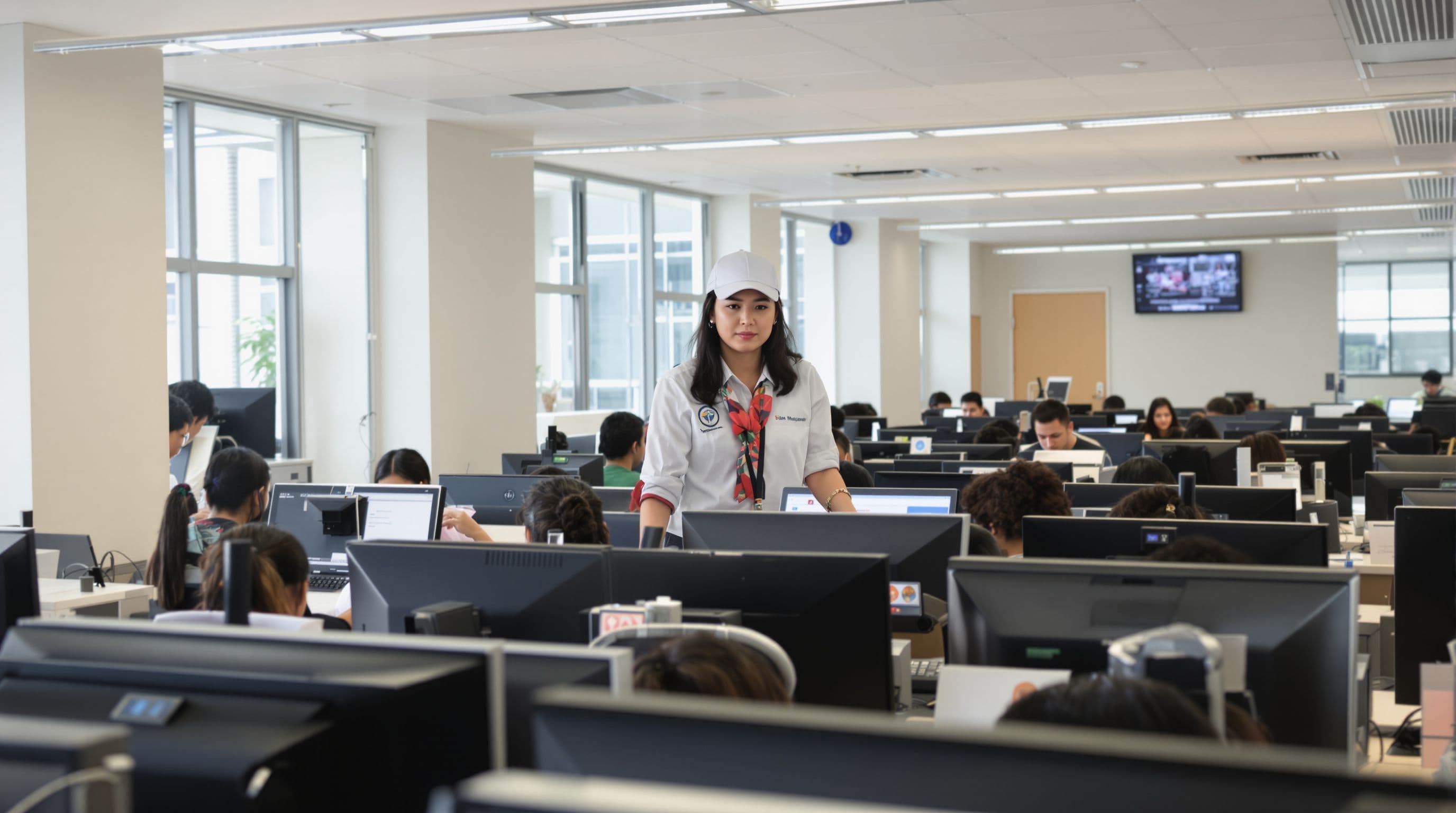
Practical AI applications that give teachers time back. Focus on high-impact, low-risk uses for lesson planning, resource creation, and communication.
Article

Comprehensive academic honesty policy template for AI use in schools. Includes use categories, disclosure requirements, consequences, and implementation roadmap.
Article

Practical strategies for creating assessments that promote genuine learning regardless of AI availability. Focus on process, personalization, and verification.
Vocational and trade schools provide technical training preparing students for skilled trades and technical careers including manufacturing, healthcare, automotive, and construction. AI personalizes learning paths, delivers hands-on simulation training, tracks skill mastery, and predicts job placement success. Schools using AI improve student completion rates by 45%, increase job placement rates by 60%, and reduce training time by 35%. The sector serves 16 million students annually across 10,000+ institutions, generating $38 billion in revenue. Programs typically range from 6 weeks to 2 years, with tuition from $5,000 to $30,000 per credential. Key technologies include learning management systems, virtual reality training simulators, skills assessment platforms, and industry-specific software tools. Revenue drivers include tuition fees, corporate training contracts, employer partnerships, and continuing education programs. Major pain points include high student dropout rates (averaging 40%), difficulty demonstrating ROI to employers, expensive equipment maintenance, instructor shortages in specialized trades, and rapidly changing industry skill requirements. Traditional one-size-fits-all curricula fail to address individual learning speeds and career goals. Digital transformation opportunities center on AI-powered adaptive learning that customizes training pace and content, predictive analytics identifying at-risk students for early intervention, VR/AR simulations reducing equipment costs while increasing practice time, automated skills tracking aligned with industry certifications, and data-driven employer matching systems that improve placement outcomes and strengthen workforce partnerships.
Timeline details will be provided for your specific engagement.
We'll work with you to determine specific requirements for your engagement.
Every engagement is tailored to your specific needs and investment varies based on scope and complexity.
Get a Custom QuoteAnalysis of 12,000 trade certification students across HVAC, welding, and electrical programs showed first-attempt pass rates improved from 68% to 91% with AI-personalized study paths.
Drawing on methodologies from Global Tech Company AI Training, trade schools implementing virtual welding and CNC machining simulators cut physical material waste and equipment maintenance costs while students scored 28% higher on practical assessments.
Real-time engagement tracking and predictive analytics identified at-risk students 4-6 weeks earlier, enabling timely academic support and reducing attrition from 31% to 23% across diesel mechanics and cosmetology programs.
AI-powered adaptive learning platforms assess each student's baseline knowledge, learning pace, and preferred learning style to create customized training pathways. For example, in a welding program, one student might need additional practice on joint preparation fundamentals while another can advance quickly to specialized techniques like TIG welding. The AI continuously adjusts content difficulty, recommends supplementary materials, and identifies knowledge gaps before they compound into failures. This is particularly powerful in vocational settings where students often arrive with diverse backgrounds—some with prior industry experience, others completely new to the trade. We've seen trade schools implement AI learning systems that break down complex skills into micro-competencies, allowing students to progress through mastery-based modules rather than rigid time-based schedules. When a HVAC student struggles with electrical theory but excels at mechanical systems, the AI allocates more practice time and alternative explanations for the challenging areas while preventing boredom in stronger areas. This targeted approach addresses the 40% average dropout rate by ensuring students don't fall behind or lose engagement. Schools using these systems report completion rate improvements of 45% because students receive the exact support they need, when they need it, without the stigma of being "slow" or the frustration of being held back by class-wide pacing.
The financial case for VR/AR simulators in trade education is compelling, with most schools seeing positive ROI within 18-24 months. Initial investment typically ranges from $50,000 to $200,000 depending on program scope, but the cost savings accumulate rapidly. Consider a heavy equipment operation program: a single excavator costs $100,000+ to purchase, requires insurance, maintenance, fuel, and dedicated outdoor space. VR simulators allow 20+ students to practice simultaneously in a single classroom, eliminate consumable costs, and enable safe practice of dangerous scenarios (equipment rollovers, underground utility strikes) that would be impossible to recreate with real machinery. Beyond direct cost savings, we see accelerated skill development that reduces overall training time by 35%. Automotive students using VR diagnostic training can practice on hundreds of vehicle models and failure scenarios without needing an inventory of actual cars. Welding simulators provide real-time feedback on angle, speed, and technique—correcting errors immediately rather than after wasting expensive materials. The hidden ROI comes from increased capacity: schools can train more students with the same physical footprint and instructor hours. One Midwest technical college reported that VR welding booths allowed them to increase enrollment by 60% without expanding their facility, generating an additional $480,000 in annual tuition revenue while reducing material costs by $75,000.
AI-powered skills assessment platforms provide granular, objective data that transforms conversations with employer partners from subjective testimonials to concrete competency verification. These systems track every student interaction—simulation performance, hands-on assessments, theoretical knowledge tests, and even soft skills like problem-solving approaches—creating detailed competency profiles aligned with industry certifications and specific employer requirements. When a manufacturing company needs CNC machinists, schools can provide data showing exactly which students have mastered specific machine types, tolerance requirements, and safety protocols, rather than simply handing over a list of graduates. We recommend implementing predictive analytics that forecast job placement success and long-term employee retention based on training performance patterns. One plumbing trade school used AI to analyze five years of graduate data, identifying that students who completed certain simulation modules with specific proficiency scores had 85% one-year retention rates with employer partners versus 52% for those who barely passed. They now use these insights to structure corporate training contracts with performance guarantees, charging premium rates because they can demonstrate predicted outcomes. This data-driven approach has helped schools increase corporate training contracts by 60%, as employers see verifiable ROI. The AI also enables continuous curriculum improvement by identifying which training modules correlate most strongly with workplace success, ensuring programs stay aligned with real-world demands rather than outdated industry assumptions.
Instructor resistance is the most underestimated barrier to AI adoption in trade schools, where teaching staff typically come from industry careers rather than educational technology backgrounds. A master electrician with 30 years of field experience may feel threatened by AI systems that seem to diminish their expertise or overwhelmed by platforms that require new technical skills. The key is positioning AI as a teaching amplifier rather than a replacement—freeing instructors from administrative burdens so they can focus on high-value mentorship and hands-on guidance that machines cannot replicate. We recommend starting with AI tools that solve instructors' most painful problems rather than forcing comprehensive platform adoption. For example, automated skills tracking systems that handle grading and progress monitoring can save instructors 8-10 hours weekly, time they'd rather spend in the shop with students. Once they experience this benefit, resistance to other AI tools decreases significantly. Pair technology rollout with practical, trade-specific training—show the welding instructor how the VR simulator's AI feedback identifies the exact students who need help with travel speed versus those struggling with arc length, making their one-on-one coaching time more effective. Successful schools also create instructor champions who receive advanced training and support their peers, translating technical features into practical teaching applications. The transition takes 6-12 months of consistent support, but schools that invest in proper change management see instructor satisfaction actually increase as AI handles routine tasks and provides insights that make their expertise more impactful.
Start with AI-powered early warning systems that identify at-risk students before they drop out—this delivers immediate, measurable impact with relatively low investment. Platforms like these analyze attendance patterns, assessment performance, LMS engagement, and even demographic factors to flag students who need intervention, typically costing $10,000-$25,000 annually depending on student population. For a school losing 40% of students to dropout, reducing that by even 10 percentage points represents hundreds of thousands in retained tuition revenue. The system pays for itself quickly while you build institutional AI literacy and demonstrate value to skeptical stakeholders. We suggest pairing the early warning system with a focused VR/AR pilot program in your highest-enrollment or most equipment-intensive program. Rather than trying to transform your entire curriculum, invest $20,000-$30,000 in simulators for one trade—perhaps welding or heavy equipment operation—where the cost-benefit case is clearest. Run it for one term, collect detailed data on student performance, material savings, and equipment utilization, then use those results to secure additional funding for expansion. This approach builds internal expertise gradually, allows you to learn from mistakes in a contained environment, and creates compelling proof points for broader investment. Avoid the temptation to spread limited budget across multiple superficial implementations. One fully-realized AI application that demonstrably improves outcomes is worth more than five half-implemented tools that frustrate staff and students while delivering marginal value.
Let's discuss how we can help you achieve your AI transformation goals.
"Can AI truly prepare students for hands-on trades that require physical practice?"
We address this concern through proven implementation strategies.
"How do we ensure AI-matched employers meet our quality and ethical standards?"
We address this concern through proven implementation strategies.
"Will students feel comfortable with AI-powered career guidance versus human advisors?"
We address this concern through proven implementation strategies.
"What happens to our career services staff with AI-automated placement?"
We address this concern through proven implementation strategies.
No benchmark data available yet.
