
THE LANDSCAPE
Vocational and trade schools provide technical training preparing students for skilled trades and technical careers including manufacturing, healthcare, automotive, and construction. AI personalizes learning paths, delivers hands-on simulation training, tracks skill mastery, and predicts job placement success. Schools using AI improve student completion rates by 45%, increase job placement rates by 60%, and reduce training time by 35%.
The sector serves 16 million students annually across 10,000+ institutions, generating $38 billion in revenue. Programs typically range from 6 weeks to 2 years, with tuition from $5,000 to $30,000 per credential.
DEEP DIVE
Key technologies include learning management systems, virtual reality training simulators, skills assessment platforms, and industry-specific software tools. Revenue drivers include tuition fees, corporate training contracts, employer partnerships, and continuing education programs.
We understand the unique regulatory, procurement, and cultural context of operating in New Zealand
Governs personal information handling, includes principles for automated decision-making and algorithmic transparency
Voluntary commitment by government agencies for transparent, accountable use of algorithms and data
Industry-led framework promoting responsible AI development and adoption across sectors
No mandatory data localization requirements for most sectors. Financial services data typically held locally per industry practice and RBNZ expectations. Public sector agencies prefer NZ-based data storage but not legally required except for classified information. Cross-border data transfers permitted under Privacy Act 2020 with adequate safeguards. Cloud providers with Australian regions commonly accepted as quasi-local (AWS Sydney, Azure Australia, Google Cloud Sydney).
Government procurement follows Government Rules of Sourcing with open tender processes via GETS portal. Medium procurement timelines (3-6 months typical). Strong preference for local vendors or those with NZ presence, though Australian vendors treated favorably under CER agreement. SME-friendly procurement with lower value thresholds. Enterprise sector favors vendors with local support capabilities and references. Proof-of-concept approach common before full deployment. Decision-making involves cross-functional committees with CFO/CTO joint authority.
Callaghan Innovation provides R&D grants including AI/ML projects with up to 40% co-funding for eligible research. Regional Business Partner Network offers capability building support for SMEs. No specific AI tax incentives but 15% R&D tax credit (uncapped) available for qualifying development. New Zealand Trade and Enterprise (NZTE) supports AI export ventures. Limited venture capital compared to Australia, government co-investment through Elevate NZ Venture Fund.
Egalitarian business culture with flat hierarchies and direct communication preferred. Consensus-driven decision-making but faster than Asian markets. Relationship-building important but less formal than Asia-Pacific neighbors. Māori cultural considerations increasingly important in public sector and corporate governance (Te Tiriti o Waitangi principles). Pragmatic, risk-aware approach to technology adoption—strong emphasis on proven value before scaling. Work-life balance highly valued, affects project timeline expectations. Geographic isolation drives preference for self-sufficiency and local capability building.
CHALLENGES WE SEE
High student dropout rates due to inability to track individual skill gaps and provide personalized support at scale.
Difficulty maintaining up-to-date curriculum aligned with rapidly changing industry certification requirements and employer needs.
Limited hands-on training capacity with expensive equipment leading to long wait times and insufficient practice hours.
Inefficient job placement processes with poor visibility into which students are ready for employment and matching them to employer needs.
Inconsistent skill assessment across instructors making it difficult to verify competency standards and certification readiness.
Low enrollment conversion rates due to lack of personalized career pathway guidance for prospective students.
Explore articles and research about AI implementation in this sector and region
Article

Measure the effectiveness of AI training programs through comprehensive post-training evaluation. Learn how to assess knowledge transfer, skill application, and behavior change.
Article
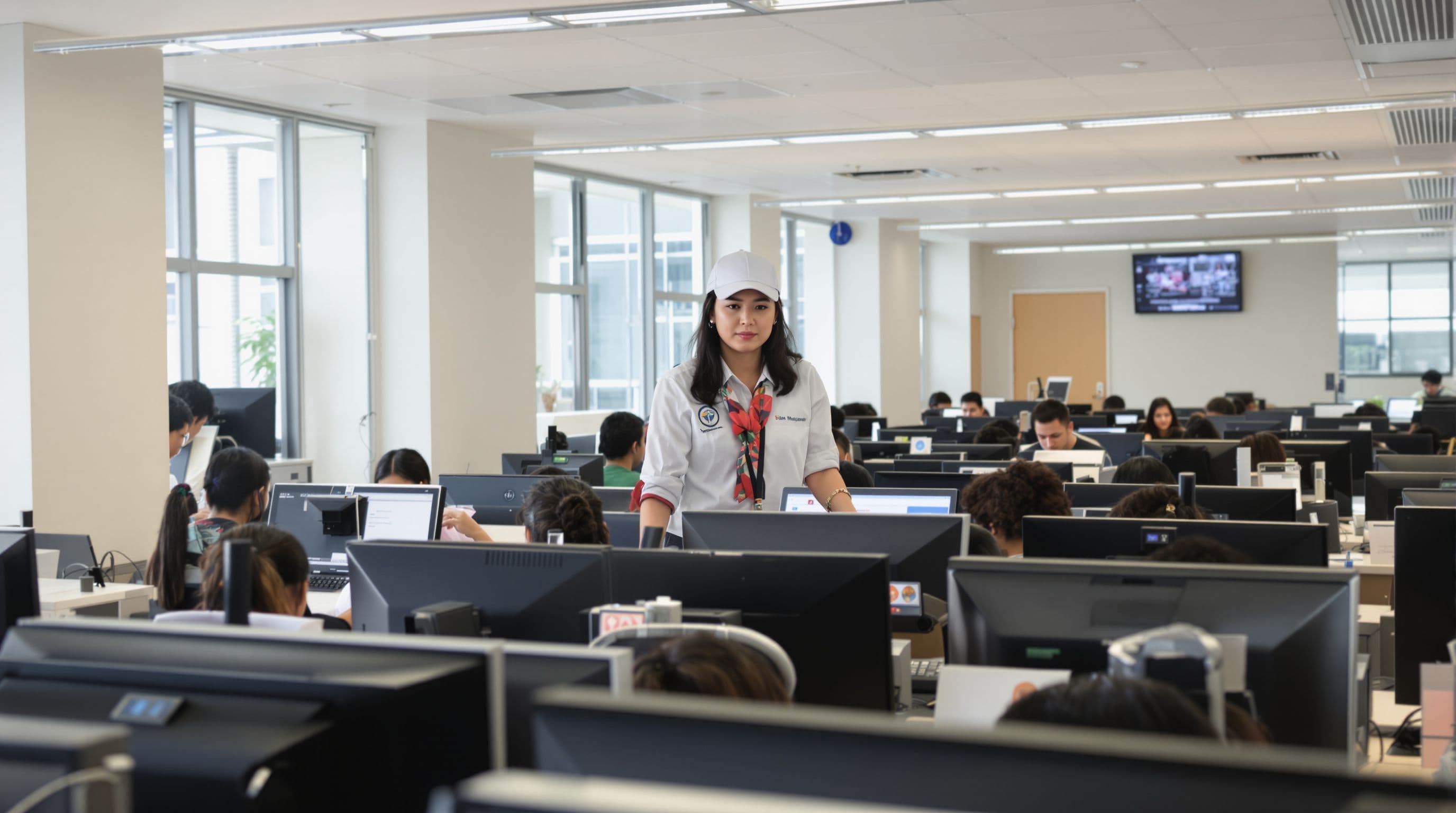
Practical AI applications that give teachers time back. Focus on high-impact, low-risk uses for lesson planning, resource creation, and communication.
Article

Comprehensive academic honesty policy template for AI use in schools. Includes use categories, disclosure requirements, consequences, and implementation roadmap.
Article

Practical strategies for creating assessments that promote genuine learning regardless of AI availability. Focus on process, personalization, and verification.
Our team has trained executives at globally-recognized brands


YOUR PATH FORWARD
Every AI transformation is different, but the journey follows a proven sequence. Start where you are. Scale when you're ready.
ASSESS · 2-3 days
Understand exactly where you stand and where the biggest opportunities are. We map your AI maturity across strategy, data, technology, and culture, then hand you a prioritized action plan.
Get your AI Maturity ScorecardChoose your path
TRAIN · 1 day minimum
Upskill your leadership and teams so AI adoption sticks. Hands-on programs tailored to your industry, with measurable proficiency gains.
Explore training programsPROVE · 30 days
Deploy a working AI solution on a real business problem and measure actual results. Low risk, high signal. The fastest way to build internal conviction.
Launch a pilotSCALE · 1-6 months
Roll out what works across the organization with governance, change management, and measurable ROI. We embed with your team so capability transfers, not just deliverables.
Design your rolloutITERATE & ACCELERATE · Ongoing
AI moves fast. Regular reassessment ensures you stay ahead, not behind. We help you iterate, optimize, and capture new opportunities as the technology landscape shifts.
Plan your next phaseAI-powered adaptive learning platforms assess each student's baseline knowledge, learning pace, and preferred learning style to create customized training pathways. For example, in a welding program, one student might need additional practice on joint preparation fundamentals while another can advance quickly to specialized techniques like TIG welding. The AI continuously adjusts content difficulty, recommends supplementary materials, and identifies knowledge gaps before they compound into failures. This is particularly powerful in vocational settings where students often arrive with diverse backgrounds—some with prior industry experience, others completely new to the trade. We've seen trade schools implement AI learning systems that break down complex skills into micro-competencies, allowing students to progress through mastery-based modules rather than rigid time-based schedules. When a HVAC student struggles with electrical theory but excels at mechanical systems, the AI allocates more practice time and alternative explanations for the challenging areas while preventing boredom in stronger areas. This targeted approach addresses the 40% average dropout rate by ensuring students don't fall behind or lose engagement. Schools using these systems report completion rate improvements of 45% because students receive the exact support they need, when they need it, without the stigma of being "slow" or the frustration of being held back by class-wide pacing.
The financial case for VR/AR simulators in trade education is compelling, with most schools seeing positive ROI within 18-24 months. Initial investment typically ranges from $50,000 to $200,000 depending on program scope, but the cost savings accumulate rapidly. Consider a heavy equipment operation program: a single excavator costs $100,000+ to purchase, requires insurance, maintenance, fuel, and dedicated outdoor space. VR simulators allow 20+ students to practice simultaneously in a single classroom, eliminate consumable costs, and enable safe practice of dangerous scenarios (equipment rollovers, underground utility strikes) that would be impossible to recreate with real machinery. Beyond direct cost savings, we see accelerated skill development that reduces overall training time by 35%. Automotive students using VR diagnostic training can practice on hundreds of vehicle models and failure scenarios without needing an inventory of actual cars. Welding simulators provide real-time feedback on angle, speed, and technique—correcting errors immediately rather than after wasting expensive materials. The hidden ROI comes from increased capacity: schools can train more students with the same physical footprint and instructor hours. One Midwest technical college reported that VR welding booths allowed them to increase enrollment by 60% without expanding their facility, generating an additional $480,000 in annual tuition revenue while reducing material costs by $75,000.
AI-powered skills assessment platforms provide granular, objective data that transforms conversations with employer partners from subjective testimonials to concrete competency verification. These systems track every student interaction—simulation performance, hands-on assessments, theoretical knowledge tests, and even soft skills like problem-solving approaches—creating detailed competency profiles aligned with industry certifications and specific employer requirements. When a manufacturing company needs CNC machinists, schools can provide data showing exactly which students have mastered specific machine types, tolerance requirements, and safety protocols, rather than simply handing over a list of graduates. We recommend implementing predictive analytics that forecast job placement success and long-term employee retention based on training performance patterns. One plumbing trade school used AI to analyze five years of graduate data, identifying that students who completed certain simulation modules with specific proficiency scores had 85% one-year retention rates with employer partners versus 52% for those who barely passed. They now use these insights to structure corporate training contracts with performance guarantees, charging premium rates because they can demonstrate predicted outcomes. This data-driven approach has helped schools increase corporate training contracts by 60%, as employers see verifiable ROI. The AI also enables continuous curriculum improvement by identifying which training modules correlate most strongly with workplace success, ensuring programs stay aligned with real-world demands rather than outdated industry assumptions.
Instructor resistance is the most underestimated barrier to AI adoption in trade schools, where teaching staff typically come from industry careers rather than educational technology backgrounds. A master electrician with 30 years of field experience may feel threatened by AI systems that seem to diminish their expertise or overwhelmed by platforms that require new technical skills. The key is positioning AI as a teaching amplifier rather than a replacement—freeing instructors from administrative burdens so they can focus on high-value mentorship and hands-on guidance that machines cannot replicate. We recommend starting with AI tools that solve instructors' most painful problems rather than forcing comprehensive platform adoption. For example, automated skills tracking systems that handle grading and progress monitoring can save instructors 8-10 hours weekly, time they'd rather spend in the shop with students. Once they experience this benefit, resistance to other AI tools decreases significantly. Pair technology rollout with practical, trade-specific training—show the welding instructor how the VR simulator's AI feedback identifies the exact students who need help with travel speed versus those struggling with arc length, making their one-on-one coaching time more effective. Successful schools also create instructor champions who receive advanced training and support their peers, translating technical features into practical teaching applications. The transition takes 6-12 months of consistent support, but schools that invest in proper change management see instructor satisfaction actually increase as AI handles routine tasks and provides insights that make their expertise more impactful.
Start with AI-powered early warning systems that identify at-risk students before they drop out—this delivers immediate, measurable impact with relatively low investment. Platforms like these analyze attendance patterns, assessment performance, LMS engagement, and even demographic factors to flag students who need intervention, typically costing $10,000-$25,000 annually depending on student population. For a school losing 40% of students to dropout, reducing that by even 10 percentage points represents hundreds of thousands in retained tuition revenue. The system pays for itself quickly while you build institutional AI literacy and demonstrate value to skeptical stakeholders. We suggest pairing the early warning system with a focused VR/AR pilot program in your highest-enrollment or most equipment-intensive program. Rather than trying to transform your entire curriculum, invest $20,000-$30,000 in simulators for one trade—perhaps welding or heavy equipment operation—where the cost-benefit case is clearest. Run it for one term, collect detailed data on student performance, material savings, and equipment utilization, then use those results to secure additional funding for expansion. This approach builds internal expertise gradually, allows you to learn from mistakes in a contained environment, and creates compelling proof points for broader investment. Avoid the temptation to spread limited budget across multiple superficial implementations. One fully-realized AI application that demonstrably improves outcomes is worth more than five half-implemented tools that frustrate staff and students while delivering marginal value.
Let's discuss how we can help you achieve your AI transformation goals.
