
Singapore's restaurant group sector is defined by established operators like the Les Amis Group, Unlisted Collection, The Lo & Behold Group, Jumbo Group (Jumbo Seafood), and Japan Foods Holding, competing in one of Asia's most demanding dining markets. The city's Michelin Guide presence, hawker culture, and cosmopolitan consumer base create high expectations for both quality and value. Rising rental costs (often 15-25% of revenue), labour shortages under MOM's foreign worker framework, and food cost inflation are driving multi-unit operators toward AI solutions for margin protection.
Singapore's acute labour shortage in F&B—with restrictions on foreign worker quotas under the dependency ratio ceiling—makes AI workforce optimization a necessity rather than a luxury for restaurant groups. The high rental costs across prime dining locations in Orchard Road, Marina Bay, and shophouse districts mean AI must help maximize revenue per square foot through optimized table turnover and dynamic pricing. Singapore's diverse dining expectations (from hawker-level value to fine dining innovation) require AI tools that can adapt across different brand concepts within the same restaurant group portfolio.
The Singapore Food Agency (SFA) regulates food safety under the Environmental Public Health Act, with all food establishments requiring SFA licensing. The Ministry of Manpower (MOM) controls foreign worker quotas through the Services sector dependency ratio ceiling and S Pass/Work Permit framework. The National Environment Agency (NEA) enforces hawker centre and food court regulations. PDPA governs customer data collected through reservation systems and loyalty programmes, and the upcoming Workplace Fairness Legislation will add new compliance requirements for AI-assisted hiring and scheduling.
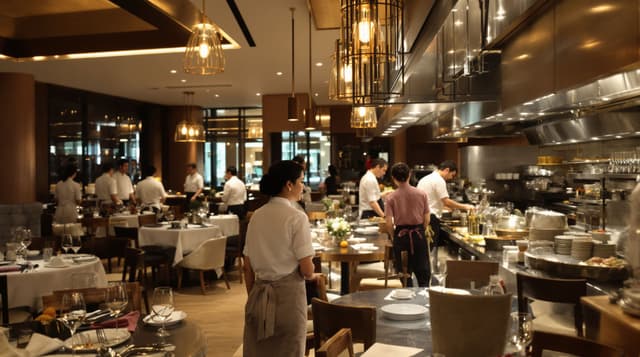
We understand the unique regulatory, procurement, and cultural context of operating in Singapore
Singapore's data protection law requiring consent for personal data collection and use. AI systems handling personal data must comply with PDPA obligations including notification, access, and correction requirements.
Monetary Authority of Singapore guidelines for responsible AI use in financial services. Emphasizes explainability, fairness, and accountability in AI decision-making for banking and finance applications.
IMDA and PDPC framework providing guidance on responsible AI deployment across all sectors. Covers human oversight, explainability, repeatability, and safety considerations for AI systems.
Financial services data must remain in Singapore per MAS regulations. Public sector data governed by Government Instruction Manuals. No strict data localization for non-sensitive commercial data. Cloud providers commonly used: AWS Singapore, Google Cloud Singapore, Azure Singapore.
Enterprise procurement typically involves 3-month evaluation cycles with formal RFP process. Government procurement follows GeBIZ tender system with 2-4 week quotation periods. Decision-making concentrated at C-suite level. Budget approvals typically require board approval for >S$100K. Pilot programs (S$20-50K) can be approved by VPs/Directors.
SkillsFuture Enterprise Credit (SFEC) provides up to 90% funding for employee training, capped at S$10K per organization per year. Enterprise Development Grant (EDG) covers up to 50% of qualifying project costs including AI implementation. Productivity Solutions Grant (PSG) supports pre-scoped AI solutions with up to 50% funding.
Highly educated workforce with strong English proficiency. Low power distance enables direct communication with senior management. Results-oriented culture values efficiency and measurable outcomes. Fast adoption of technology but risk-averse in implementation. Prefer proof-of-concept before full deployment.
Explore articles and research about AI implementation in this sector and region
Article

A guide to prompt engineering courses for Singaporean companies in 2026. SkillsFuture subsidised workshops covering prompt patterns, structured output techniques, and governance.
Article

AI governance courses for Singaporean companies in 2026. SkillsFuture subsidised programmes covering PDPA compliance, IMDA Model AI Framework, MAS guidelines, and responsible AI.
Article

Singapore's Model AI Governance Framework has evolved through three editions — Traditional AI (2020), Generative AI (2024), and Agentic AI (2026). Together they form the most comprehensive voluntary AI governance framework in Asia.
Article

The Monetary Authority of Singapore (MAS) released AI Risk Management Guidelines in November 2025 for all financial institutions. Built on the FEAT principles, these guidelines establish comprehensive AI governance requirements for banks, insurers, and fintechs.
Our team has trained executives at globally-recognized brands


YOUR PATH FORWARD
Every AI transformation is different, but the journey follows a proven sequence. Start where you are. Scale when you're ready.
ASSESS · 2-3 days
Understand exactly where you stand and where the biggest opportunities are. We map your AI maturity across strategy, data, technology, and culture, then hand you a prioritized action plan.
Get your AI Maturity ScorecardChoose your path
TRAIN · 1 day minimum
Upskill your leadership and teams so AI adoption sticks. Hands-on programs tailored to your industry, with measurable proficiency gains.
Explore training programsPROVE · 30 days
Deploy a working AI solution on a real business problem and measure actual results. Low risk, high signal. The fastest way to build internal conviction.
Launch a pilotSCALE · 1-6 months
Roll out what works across the organization with governance, change management, and measurable ROI. We embed with your team so capability transfers, not just deliverables.
Design your rolloutITERATE & ACCELERATE · Ongoing
AI moves fast. Regular reassessment ensures you stay ahead, not behind. We help you iterate, optimize, and capture new opportunities as the technology landscape shifts.
Plan your next phaseAI-powered workforce scheduling can optimize shift patterns to maximize productivity from a smaller headcount, critical when restaurant groups face hard limits on foreign worker hiring under MOM's dependency ratio ceiling. Predictive demand modelling allows groups to right-size staffing for each service period rather than maintaining excess staff during quiet periods. Some Singapore restaurant groups are also using AI to identify which tasks can be automated (ordering, payment processing, basic food preparation) to reduce total headcount requirements while maintaining service standards.
AI revenue management tools can optimize table allocation and reservation pacing to maximize covers during peak periods, directly improving revenue per square foot. Dynamic pricing models—already common in hotels—are being adapted for restaurants, with AI adjusting set menu pricing or implementing time-based promotions to smooth demand across service periods. For groups operating multiple concepts, AI analytics can inform decisions about which brand concepts generate the highest revenue per square foot for specific locations, guiding portfolio strategy and lease renewal decisions.
Let's discuss how we can help you achieve your AI transformation goals.
