
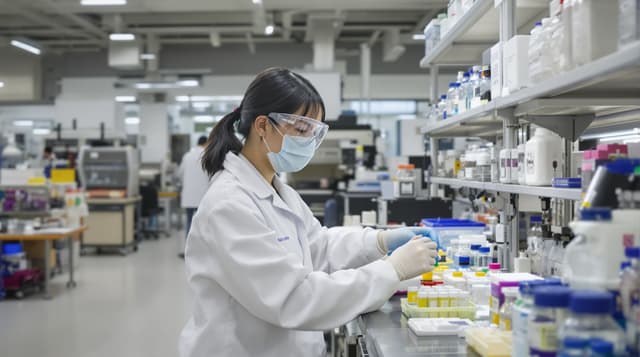
Thailand's life sciences sector benefits from strong government support through NSTDA's biotechnology programs, the Thailand Center of Excellence for Life Sciences (TCELS), and the BCG economic model's emphasis on bio-based industries. The country hosts major pharmaceutical manufacturers, contract research organizations (CROs), and a growing biotech startup ecosystem. AI adoption for drug discovery, clinical trial optimization, and genomic research is advancing through partnerships between Thai universities (Mahidol, Chulalongkorn) and international pharmaceutical companies, with the EEC's bio-corridor attracting investment in AI-enabled life sciences infrastructure.
Thailand's life sciences AI adoption faces limited access to large-scale genomic and clinical datasets, as the country's biobank infrastructure is still developing. The regulatory pathway for AI-assisted drug development through the Thai FDA is not yet fully defined, creating uncertainty for companies investing in AI-driven discovery. The talent pool combining life sciences domain expertise with AI skills is extremely small in Thailand. Intellectual property protection concerns—despite improvements in Thailand's IP regime—deter some companies from deploying proprietary AI models in the Thai research ecosystem.
TCELS under MHESI coordinates life sciences policy and research funding that can support AI development. The Thai FDA regulates pharmaceuticals and biologics, and AI-assisted drug development must meet FDA efficacy and safety requirements. The National Ethics Committee oversees research ethics for AI-driven clinical studies. Thailand's participation in the ASEAN Pharmaceutical Regulatory Framework affects how AI-developed products navigate regional approvals. The Plant Variety Protection Act and Biodiversity Act govern the use of Thai biological resources in AI-driven bio-discovery.
We understand the unique regulatory, procurement, and cultural context of operating in Thailand
Thailand's 2019 PDPA modeled on GDPR, enforced from 2022. Requires consent for personal data processing with penalties up to 5M THB. AI systems collecting personal data must comply with data subject rights including access and deletion.
Requires critical infrastructure operators to implement security measures. AI systems in banking, telecom, and utilities sectors face additional security and monitoring requirements.
Banking and financial data must be stored in Thailand per Bank of Thailand regulations. Government data subject to data localization under Cybersecurity Act. Commercial data can use regional cloud (AWS Bangkok, Google Cloud Bangkok, Azure Thailand).
Thai conglomerates (CP Group, TCC, Siam Cement) follow formal procurement with 3-5 month cycles. Government procurement via e-GP system requires Thai entity or local partnership. Decision-making hierarchical with CEO/board approval for >10M THB. Family-owned businesses allow faster decisions with owner approval. Relationship building critical for enterprise sales.
Ministry of Labour offers training subsidies through Social Security Fund for employee skills development. BOI (Board of Investment) grants for technology adoption in promoted industries. Digital Economy Promotion Agency (DEPA) provides AI adoption grants for SMEs. Limited compared to Singapore but growing under Thailand 4.0 initiative.
High power distance requires respect for hierarchy and seniority. Thai language training delivery preferred even when management speaks English. 'Kreng jai' (consideration) culture avoids direct confrontation or negative feedback. Decision-making involves face-to-face meetings and relationship building. Buddhist values emphasize harmony and consensus. Avoid loss of face in training scenarios.
Explore articles and research about AI implementation in this sector and region
Article

A guide to the best AI courses for Thai companies in 2026. BOI-supported programmes, corporate workshops in Bangkok and Chiang Mai, and online options for distributed teams.
Article

Thailand's PDPA imposes strict data protection requirements on AI systems. With a draft AI law expected in 2026 and new BOT AI guidelines for financial services, companies must prepare for an increasingly regulated environment.
Article
Comprehensive compliance guide for AI in HR covering employment law, data protection, and emerging AI regulations in Singapore, Malaysia, and Thailand.
Article

Compliance-focused guide for AI customer service implementations covering data handling, privacy requirements, and regulations for Singapore, Malaysia, and Thailand.
Our team has trained executives at globally-recognized brands


YOUR PATH FORWARD
Every AI transformation is different, but the journey follows a proven sequence. Start where you are. Scale when you're ready.
ASSESS · 2-3 days
Understand exactly where you stand and where the biggest opportunities are. We map your AI maturity across strategy, data, technology, and culture, then hand you a prioritized action plan.
Get your AI Maturity ScorecardChoose your path
TRAIN · 1 day minimum
Upskill your leadership and teams so AI adoption sticks. Hands-on programs tailored to your industry, with measurable proficiency gains.
Explore training programsPROVE · 30 days
Deploy a working AI solution on a real business problem and measure actual results. Low risk, high signal. The fastest way to build internal conviction.
Launch a pilotSCALE · 1-6 months
Roll out what works across the organization with governance, change management, and measurable ROI. We embed with your team so capability transfers, not just deliverables.
Design your rolloutITERATE & ACCELERATE · Ongoing
AI moves fast. Regular reassessment ensures you stay ahead, not behind. We help you iterate, optimize, and capture new opportunities as the technology landscape shifts.
Plan your next phaseTCELS provides funding and coordination for life sciences innovation, including AI applications in drug discovery, medical device development, and precision medicine. TCELS partners with NSTDA and Thai universities to build research infrastructure and has supported AI-related life sciences projects through its grant programs. The center also facilitates connections between Thai life sciences companies and international AI technology providers.
The EEC's designated bio-corridor and medical hub zone attract investment in AI-enabled life sciences facilities, offering BOI investment privileges including extended tax exemptions. The EEC's proximity to research universities and the planned Eastern Economic Corridor of Medical Hub (EECm) provide infrastructure for clinical AI research. Companies establishing life sciences R&D centers in the EEC can access both BOI incentives and DEPA digital transformation support for AI development.
Let's discuss how we can help you achieve your AI transformation goals.
