
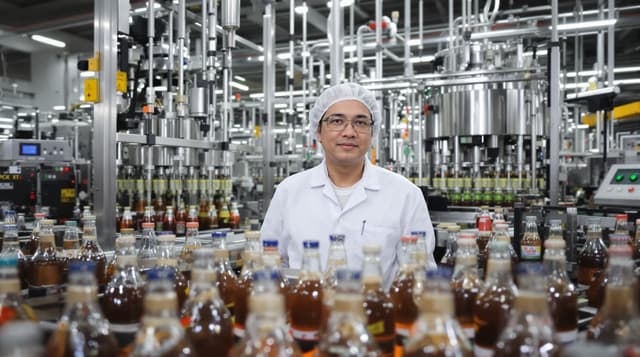
Singapore's food and beverage manufacturing sector is strategically important for the nation's '30 by 30' food security goal, targeting 30% of nutritional needs produced locally by 2030. SFA (Singapore Food Agency) actively supports AI adoption for food safety monitoring, production optimisation, and novel food development. Companies at the JTC Food Hub@Senoko and Jurong Food Hub are deploying AI for automated quality control, shelf-life prediction, and demand forecasting to reduce food waste, a key priority under the Zero Waste Masterplan.
F&B manufacturers face Singapore's land and labour constraints, with limited factory space and MOM foreign worker quotas driving the need for AI-powered automation. The sector must comply with SFA's stringent food safety standards while managing the complexity of sourcing ingredients from diverse global supply chains that AI must track for traceability. Singapore's multicultural consumer base demands AI product development tools that can optimise formulations for Halal certification, Chinese dietary preferences, and Indian vegetarian requirements simultaneously.
SFA regulates food manufacturing under the Sale of Food Act and Environmental Public Health Act, with AI-powered quality systems required to meet food safety standards. The SFA Food Safety and Quality Division evaluates novel food products—including those developed using AI-optimised processes—through a dedicated novel food regulatory framework. MUIS (Islamic Religious Council of Singapore) Halal certification requirements must be incorporated into AI systems managing ingredient sourcing and production processes.
We understand the unique regulatory, procurement, and cultural context of operating in Singapore
Singapore's data protection law requiring consent for personal data collection and use. AI systems handling personal data must comply with PDPA obligations including notification, access, and correction requirements.
Monetary Authority of Singapore guidelines for responsible AI use in financial services. Emphasizes explainability, fairness, and accountability in AI decision-making for banking and finance applications.
IMDA and PDPC framework providing guidance on responsible AI deployment across all sectors. Covers human oversight, explainability, repeatability, and safety considerations for AI systems.
Financial services data must remain in Singapore per MAS regulations. Public sector data governed by Government Instruction Manuals. No strict data localization for non-sensitive commercial data. Cloud providers commonly used: AWS Singapore, Google Cloud Singapore, Azure Singapore.
Enterprise procurement typically involves 3-month evaluation cycles with formal RFP process. Government procurement follows GeBIZ tender system with 2-4 week quotation periods. Decision-making concentrated at C-suite level. Budget approvals typically require board approval for >S$100K. Pilot programs (S$20-50K) can be approved by VPs/Directors.
SkillsFuture Enterprise Credit (SFEC) provides up to 90% funding for employee training, capped at S$10K per organization per year. Enterprise Development Grant (EDG) covers up to 50% of qualifying project costs including AI implementation. Productivity Solutions Grant (PSG) supports pre-scoped AI solutions with up to 50% funding.
Highly educated workforce with strong English proficiency. Low power distance enables direct communication with senior management. Results-oriented culture values efficiency and measurable outcomes. Fast adoption of technology but risk-averse in implementation. Prefer proof-of-concept before full deployment.
Explore articles and research about AI implementation in this sector and region
Article

A guide to prompt engineering courses for Singaporean companies in 2026. SkillsFuture subsidised workshops covering prompt patterns, structured output techniques, and governance.
Article

AI governance courses for Singaporean companies in 2026. SkillsFuture subsidised programmes covering PDPA compliance, IMDA Model AI Framework, MAS guidelines, and responsible AI.
Article

Singapore's Model AI Governance Framework has evolved through three editions — Traditional AI (2020), Generative AI (2024), and Agentic AI (2026). Together they form the most comprehensive voluntary AI governance framework in Asia.
Article

The Monetary Authority of Singapore (MAS) released AI Risk Management Guidelines in November 2025 for all financial institutions. Built on the FEAT principles, these guidelines establish comprehensive AI governance requirements for banks, insurers, and fintechs.
Our team has trained executives at globally-recognized brands


YOUR PATH FORWARD
Every AI transformation is different, but the journey follows a proven sequence. Start where you are. Scale when you're ready.
ASSESS · 2-3 days
Understand exactly where you stand and where the biggest opportunities are. We map your AI maturity across strategy, data, technology, and culture, then hand you a prioritized action plan.
Get your AI Maturity ScorecardChoose your path
TRAIN · 1 day minimum
Upskill your leadership and teams so AI adoption sticks. Hands-on programs tailored to your industry, with measurable proficiency gains.
Explore training programsPROVE · 30 days
Deploy a working AI solution on a real business problem and measure actual results. Low risk, high signal. The fastest way to build internal conviction.
Launch a pilotSCALE · 1-6 months
Roll out what works across the organization with governance, change management, and measurable ROI. We embed with your team so capability transfers, not just deliverables.
Design your rolloutITERATE & ACCELERATE · Ongoing
AI moves fast. Regular reassessment ensures you stay ahead, not behind. We help you iterate, optimize, and capture new opportunities as the technology landscape shifts.
Plan your next phaseThe '30 by 30' food security target creates demand for AI-optimised urban farming, alternative protein production, and precision fermentation technology. SFA's Singapore Food Story R&D Programme funds AI applications in food production efficiency and novel food development. Companies in Singapore's food tech ecosystem, like Shiok Meats and TurtleTree, use AI to accelerate alternative protein product development.
AI quality control systems must comply with SFA's food safety standards, including HACCP (Hazard Analysis Critical Control Points) requirements for manufacturing facilities. SFA conducts regular inspections where AI-generated quality records must be auditable and traceable. For manufacturers seeking MUIS Halal certification, AI systems must demonstrate that they maintain ingredient segregation and process controls consistent with Halal requirements.
Let's discuss how we can help you achieve your AI transformation goals.
