
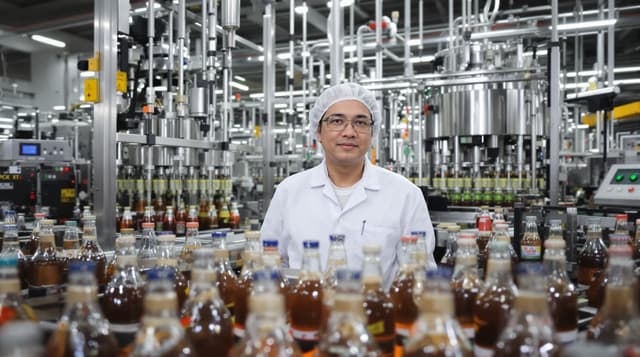
Malaysia's food and beverage manufacturing sector is a strategic industry under MITI's National Agrofood Policy 2021-2030, with major players like Nestlé Malaysia, Fraser & Neave, and Dutch Lady operating alongside SME producers of halal food products. Malaysia's position as a global halal hub—with JAKIM's halal certification recognized worldwide—creates unique AI applications for halal supply chain verification, quality assurance, and production optimization. The Malaysia External Trade Development Corporation (MATRADE) actively promotes AI-enabled halal food manufacturing for export markets.
Halal certification by JAKIM requires strict ingredient traceability and production segregation, where AI must ensure no cross-contamination with non-halal inputs—a requirement more complex than standard food safety AI. Malaysia's price-controlled essential goods (cooking oil, sugar, flour) compress margins for manufacturers, limiting AI investment budgets. The sector's reliance on migrant labor and high staff turnover in production facilities creates challenges for AI systems requiring consistent human-machine interaction.
JAKIM (Department of Islamic Development Malaysia) administers Malaysia's halal certification, while the Ministry of Health enforces the Food Act 1983 and Food Regulations 1985. MAQIS (Malaysian Quarantine and Inspection Services) controls food imports. The Malaysian Standard MS 1500:2019 for halal food production provides the framework that AI quality systems must support. SIRIM certifies manufacturing processes and product quality.
We understand the unique regulatory, procurement, and cultural context of operating in Malaysia
Malaysia's comprehensive data protection law enforced by Personal Data Protection Department (JPDP). Requires consent and notification for personal data processing. AI systems must comply with seven data protection principles. Penalties up to RM500K or 3 years imprisonment.
BNM guidelines for technology risk management covering AI and ML in financial services. Requires model validation, governance framework, and ongoing monitoring for AI systems in banking.
Government strategy for responsible AI development emphasizing ethics, governance, and talent development. Provides framework for AI adoption across public and private sectors.
Banking sector data must remain in Malaysia per BNM regulations. Government data subject to localization under MAMPU directives. No blanket data localization for commercial sector but government-linked companies (GLCs) prefer local storage. Cloud providers with Malaysia regions commonly used (AWS Malaysia, Google Cloud Malaysia, Azure Malaysia).
Government-linked companies (GLCs like Petronas, Maybank, Telekom Malaysia) follow formal procurement with 4-6 month cycles requiring local Bumiputera partnership or representation. Private sector (non-GLC) faster with 3-4 month evaluation. Ethnic quotas (Bumiputera preferences) affect vendor selection. Decision-making at group level with board approval for >RM500K. Pilot programs (RM100-300K) approved at divisional director level. Strong preference for Multimedia Super Corridor (MSC) status vendors.
HRDF (Human Resource Development Fund) provides training grants covering 50-80% of costs for registered employers. MDEC grants for digital transformation and AI adoption. Malaysia Digital Economy Corporation offers AI adoption incentives. Cradle Fund and Malaysian Investment Development Authority (MIDA) support innovation. SME Corp provides digitalization grants for small businesses.
Multi-ethnic society (Malay, Chinese, Indian) requires cultural sensitivity in training delivery. Bahasa Malaysia official language but English widely used in business. Islamic considerations important for Malay-majority workforce (prayer times, halal food, Ramadan schedules). 'Budi bahasa' (courtesy) culture values politeness and indirect communication. Bumiputera preferences affect business partnerships. Regional differences between Peninsular Malaysia and East Malaysia (Sabah, Sarawak).
Explore articles and research about AI implementation in this sector and region
Article

A guide to prompt engineering courses for Malaysian companies in 2026. HRDF claimable corporate workshops covering the 7 essential prompt patterns, role-specific prompt libraries, and hands-on practice.
Article

AI governance courses for Malaysian companies in 2026. HRDF claimable programmes covering AI policy frameworks, risk assessment, PDPA compliance, and responsible AI practices.
Article

Malaysia's PDPA amendments (effective June 2025) introduce mandatory DPO requirements, breach notifications, and data portability. Combined with the new AIGE Guidelines, companies using AI must adapt their data practices.
Article

A curated list of the best AI courses for Malaysian companies in 2026 — from HRDF claimable corporate workshops to online programmes. Includes Pertama Partners, AI Singapore, Coursera for Business, and more.
Our team has trained executives at globally-recognized brands


YOUR PATH FORWARD
Every AI transformation is different, but the journey follows a proven sequence. Start where you are. Scale when you're ready.
ASSESS · 2-3 days
Understand exactly where you stand and where the biggest opportunities are. We map your AI maturity across strategy, data, technology, and culture, then hand you a prioritized action plan.
Get your AI Maturity ScorecardChoose your path
TRAIN · 1 day minimum
Upskill your leadership and teams so AI adoption sticks. Hands-on programs tailored to your industry, with measurable proficiency gains.
Explore training programsPROVE · 30 days
Deploy a working AI solution on a real business problem and measure actual results. Low risk, high signal. The fastest way to build internal conviction.
Launch a pilotSCALE · 1-6 months
Roll out what works across the organization with governance, change management, and measurable ROI. We embed with your team so capability transfers, not just deliverables.
Design your rolloutITERATE & ACCELERATE · Ongoing
AI moves fast. Regular reassessment ensures you stay ahead, not behind. We help you iterate, optimize, and capture new opportunities as the technology landscape shifts.
Plan your next phaseAI-powered supply chain traceability systems help Malaysian food manufacturers maintain JAKIM halal compliance by automatically verifying ingredient sourcing, detecting potential cross-contamination in production lines, and generating audit-ready documentation. Computer vision systems can monitor production segregation between halal and non-halal lines, addressing a key requirement of Malaysia's MS 1500:2019 halal standard.
Food manufacturers can access MITI's Industry4WRD Readiness Assessment and Intervention Fund for AI adoption. MIDA provides investment tax allowances for automation equipment, while SME Corp's Bumiputera Enterprise Enhancement Programme (BEEP) offers matching grants for food industry digital transformation. The MATRADE Halal Industry Development Corporation also supports AI adoption for export-ready halal food producers.
Let's discuss how we can help you achieve your AI transformation goals.
