
Singapore is a global semiconductor powerhouse, hosting major fabrication facilities for GlobalFoundries, Micron, and UMC, with the sector contributing over S$100 billion in annual output. The National AI Strategy identifies semiconductors as critical infrastructure, while EDB's Electronics Industry Transformation Map targets AI-driven yield optimisation and advanced process control. A*STAR's Institute of Microelectronics (IME) and the recently established Singapore Semiconductor Industry Association (SSIA) AI working group drive sector-specific AI innovation.
Semiconductor fabs in Singapore operate at extreme precision levels where AI must achieve near-zero false positive rates in defect detection to avoid costly wafer scrapping. The global chip shortage has intensified production pressure, making AI-driven yield improvement a competitive necessity but leaving limited downtime for AI system integration. Recruiting AI engineers who understand semiconductor physics and cleanroom operations is particularly challenging in Singapore's tight labour market.
Enterprise Singapore's semiconductor quality standards align with SEMI international standards, which increasingly incorporate AI-driven inspection and process control. MOM's Workplace Safety and Health regulations govern AI-controlled equipment in cleanroom environments, with strict protocols for automated handling systems. Export controls under the Strategic Goods (Control) Act affect AI technology transfer related to advanced semiconductor manufacturing processes.
We understand the unique regulatory, procurement, and cultural context of operating in Singapore
Singapore's data protection law requiring consent for personal data collection and use. AI systems handling personal data must comply with PDPA obligations including notification, access, and correction requirements.
Monetary Authority of Singapore guidelines for responsible AI use in financial services. Emphasizes explainability, fairness, and accountability in AI decision-making for banking and finance applications.
IMDA and PDPC framework providing guidance on responsible AI deployment across all sectors. Covers human oversight, explainability, repeatability, and safety considerations for AI systems.
Financial services data must remain in Singapore per MAS regulations. Public sector data governed by Government Instruction Manuals. No strict data localization for non-sensitive commercial data. Cloud providers commonly used: AWS Singapore, Google Cloud Singapore, Azure Singapore.
Enterprise procurement typically involves 3-month evaluation cycles with formal RFP process. Government procurement follows GeBIZ tender system with 2-4 week quotation periods. Decision-making concentrated at C-suite level. Budget approvals typically require board approval for >S$100K. Pilot programs (S$20-50K) can be approved by VPs/Directors.
SkillsFuture Enterprise Credit (SFEC) provides up to 90% funding for employee training, capped at S$10K per organization per year. Enterprise Development Grant (EDG) covers up to 50% of qualifying project costs including AI implementation. Productivity Solutions Grant (PSG) supports pre-scoped AI solutions with up to 50% funding.
Highly educated workforce with strong English proficiency. Low power distance enables direct communication with senior management. Results-oriented culture values efficiency and measurable outcomes. Fast adoption of technology but risk-averse in implementation. Prefer proof-of-concept before full deployment.
Explore articles and research about AI implementation in this sector and region
Article

A guide to prompt engineering courses for Singaporean companies in 2026. SkillsFuture subsidised workshops covering prompt patterns, structured output techniques, and governance.
Article

AI governance courses for Singaporean companies in 2026. SkillsFuture subsidised programmes covering PDPA compliance, IMDA Model AI Framework, MAS guidelines, and responsible AI.
Article

Singapore's Model AI Governance Framework has evolved through three editions — Traditional AI (2020), Generative AI (2024), and Agentic AI (2026). Together they form the most comprehensive voluntary AI governance framework in Asia.
Article

The Monetary Authority of Singapore (MAS) released AI Risk Management Guidelines in November 2025 for all financial institutions. Built on the FEAT principles, these guidelines establish comprehensive AI governance requirements for banks, insurers, and fintechs.
Our team has trained executives at globally-recognized brands


YOUR PATH FORWARD
Every AI transformation is different, but the journey follows a proven sequence. Start where you are. Scale when you're ready.
ASSESS · 2-3 days
Understand exactly where you stand and where the biggest opportunities are. We map your AI maturity across strategy, data, technology, and culture, then hand you a prioritized action plan.
Get your AI Maturity ScorecardChoose your path
TRAIN · 1 day minimum
Upskill your leadership and teams so AI adoption sticks. Hands-on programs tailored to your industry, with measurable proficiency gains.
Explore training programsPROVE · 30 days
Deploy a working AI solution on a real business problem and measure actual results. Low risk, high signal. The fastest way to build internal conviction.
Launch a pilotSCALE · 1-6 months
Roll out what works across the organization with governance, change management, and measurable ROI. We embed with your team so capability transfers, not just deliverables.
Design your rolloutITERATE & ACCELERATE · Ongoing
AI moves fast. Regular reassessment ensures you stay ahead, not behind. We help you iterate, optimize, and capture new opportunities as the technology landscape shifts.
Plan your next phaseA*STAR's Institute of Microelectronics conducts AI research for semiconductor design and manufacturing, with joint labs established with industry partners. NTU and NUS offer specialised programmes combining semiconductor engineering with AI competencies. EDB has attracted over S$20 billion in semiconductor investments in recent years, with AI-enabled facilities as a key requirement for new fab projects.
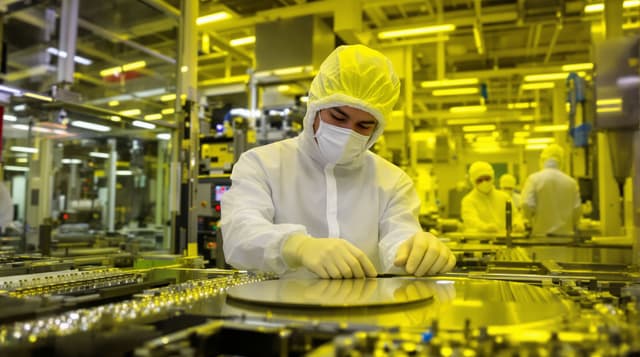
Singapore-based fabs use AI for real-time process control, predicting equipment maintenance needs, and optimising lithography parameters across production runs. Computer vision AI systems inspect wafers at multiple stages, identifying sub-micron defects faster than traditional optical inspection. A*STAR's collaboration with GlobalFoundries on AI-driven virtual metrology has demonstrated significant yield improvements in Singapore's advanced node production.
Let's discuss how we can help you achieve your AI transformation goals.
