
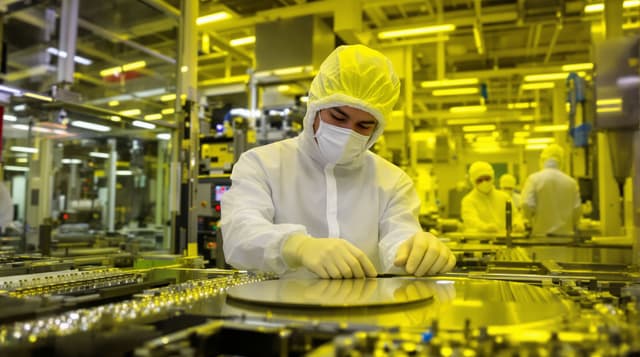
Indonesia is positioning itself as a key player in the global semiconductor supply chain, leveraging its abundant tin and rare earth mineral reserves essential for chip manufacturing. Kemenperin's Making Indonesia 4.0 identifies electronics as a priority sector, and Batam's free trade zone hosts major electronics assembly operations for companies like Infineon and Panasonic. AI-powered quality inspection, yield optimization, and supply chain management are critical for Indonesia to move up the electronics value chain from assembly to higher-value manufacturing.
Indonesia's electronics sector is concentrated in assembly and packaging rather than chip fabrication, limiting the scope of AI applications compared to more advanced semiconductor-producing countries. The talent pipeline for semiconductor engineering with AI expertise is thin, with most graduates preferring Jakarta-based tech companies over Batam or Cikarang factory positions. Power supply stability and clean room infrastructure requirements create high barriers for advanced semiconductor AI applications. Competition from Vietnam and Malaysia for electronics FDI means Indonesia must accelerate AI adoption to maintain its manufacturing cost advantage.
Kemenperin regulates electronics manufacturing standards and enforces TKDN requirements for electronics products sold in Indonesia. BKPM oversees foreign investment approvals for electronics manufacturing facilities and technology transfer agreements. Export restrictions on critical minerals like tin and nickel affect the semiconductor supply chain that AI tools must optimize around. SNI certifications and Postel (telecommunications equipment) type approvals are mandatory for electronic products, with AI helping to streamline compliance testing.
We understand the unique regulatory, procurement, and cultural context of operating in Indonesia
Indonesia's 2022 data protection law requiring data processors to obtain consent and implement security measures. Applies to AI systems handling personal data. Enforcement began 2024 with penalties up to 6 billion rupiah.
BRIN (National Research and Innovation Agency) guidelines emphasizing transparency, accountability, and human-centric AI development. Voluntary framework for responsible AI deployment across sectors.
Financial services data (banking, insurance) must be stored in Indonesia per OJK regulations. Government Regulation 71/2019 requires public sector data to remain in-country. Private sector data can use cloud providers with Indonesia regions (AWS Jakarta, Google Cloud Jakarta).
Enterprise procurement cycles 4-6 months with heavy emphasis on relationship building. State-owned enterprises (BUMN) follow formal tender processes requiring local partnership or presence. Private sector decision-making involves multiple stakeholder approval (finance, IT, business units, legal). Budget approvals centralized at group/holding company level for >500M IDR.
Prakerja program provides skills training subsidies for workers. Ministry of Industry offers Industry 4.0 readiness grants. Limited direct AI adoption subsidies compared to Singapore/Malaysia. Corporate training often funded directly by enterprises. Tax incentives available for R&D activities including AI development.
High power distance culture requires engagement with senior leadership first. Relationship building essential before business discussions. Bahasa Indonesia training delivery required despite English proficiency in management. Consensus-driven decision making involves broad stakeholder input. Regional diversity (Java, Sumatra, Sulawesi) requires localized approaches.
Explore articles and research about AI implementation in this sector and region
Article

A guide to Microsoft Copilot courses for Indonesian companies in 2026. Corporate training for M365 organisations in Jakarta and across Indonesia.
Article

A guide to ChatGPT courses for Indonesian companies in 2026. Corporate workshops in Jakarta, Surabaya, and Bandung. Kartu Prakerja eligible options and in-house training programmes.
Article

Indonesia's Personal Data Protection Law (UU PDP), fully effective since October 2024, is modeled on GDPR and applies to all AI systems processing personal data. With mandatory AI regulations expected in early 2026, companies must comply now.
Article

A guide to the best AI courses for Indonesian companies in 2026 — from Kartu Prakerja eligible programmes to corporate workshops in Jakarta, Surabaya, and Bandung.
Our team has trained executives at globally-recognized brands


YOUR PATH FORWARD
Every AI transformation is different, but the journey follows a proven sequence. Start where you are. Scale when you're ready.
ASSESS · 2-3 days
Understand exactly where you stand and where the biggest opportunities are. We map your AI maturity across strategy, data, technology, and culture, then hand you a prioritized action plan.
Get your AI Maturity ScorecardChoose your path
TRAIN · 1 day minimum
Upskill your leadership and teams so AI adoption sticks. Hands-on programs tailored to your industry, with measurable proficiency gains.
Explore training programsPROVE · 30 days
Deploy a working AI solution on a real business problem and measure actual results. Low risk, high signal. The fastest way to build internal conviction.
Launch a pilotSCALE · 1-6 months
Roll out what works across the organization with governance, change management, and measurable ROI. We embed with your team so capability transfers, not just deliverables.
Design your rolloutITERATE & ACCELERATE · Ongoing
AI moves fast. Regular reassessment ensures you stay ahead, not behind. We help you iterate, optimize, and capture new opportunities as the technology landscape shifts.
Plan your next phaseIndonesia holds significant reserves of tin (world's largest exporter), nickel, and rare earth minerals essential for semiconductor and electronics manufacturing. AI is being deployed to optimize mining and refining processes for semiconductor-grade materials, particularly in Bangka Belitung's tin operations. The government's downstream processing mandate creates demand for AI-powered quality control in mineral refining facilities that produce semiconductor-ready materials.
Batam's free trade zone hosts over 80 electronics manufacturing companies that benefit from simplified import/export procedures and proximity to Singapore's tech ecosystem. AI-powered visual inspection and automated testing systems are being deployed in Batam's assembly plants to improve yield rates and reduce defects. The zone's relatively advanced infrastructure compared to mainland Indonesia makes it a natural pilot location for AI manufacturing technologies before broader deployment across Indonesian industrial estates.
Let's discuss how we can help you achieve your AI transformation goals.
