
NSDA AI Training for Manufacturing in Thailand
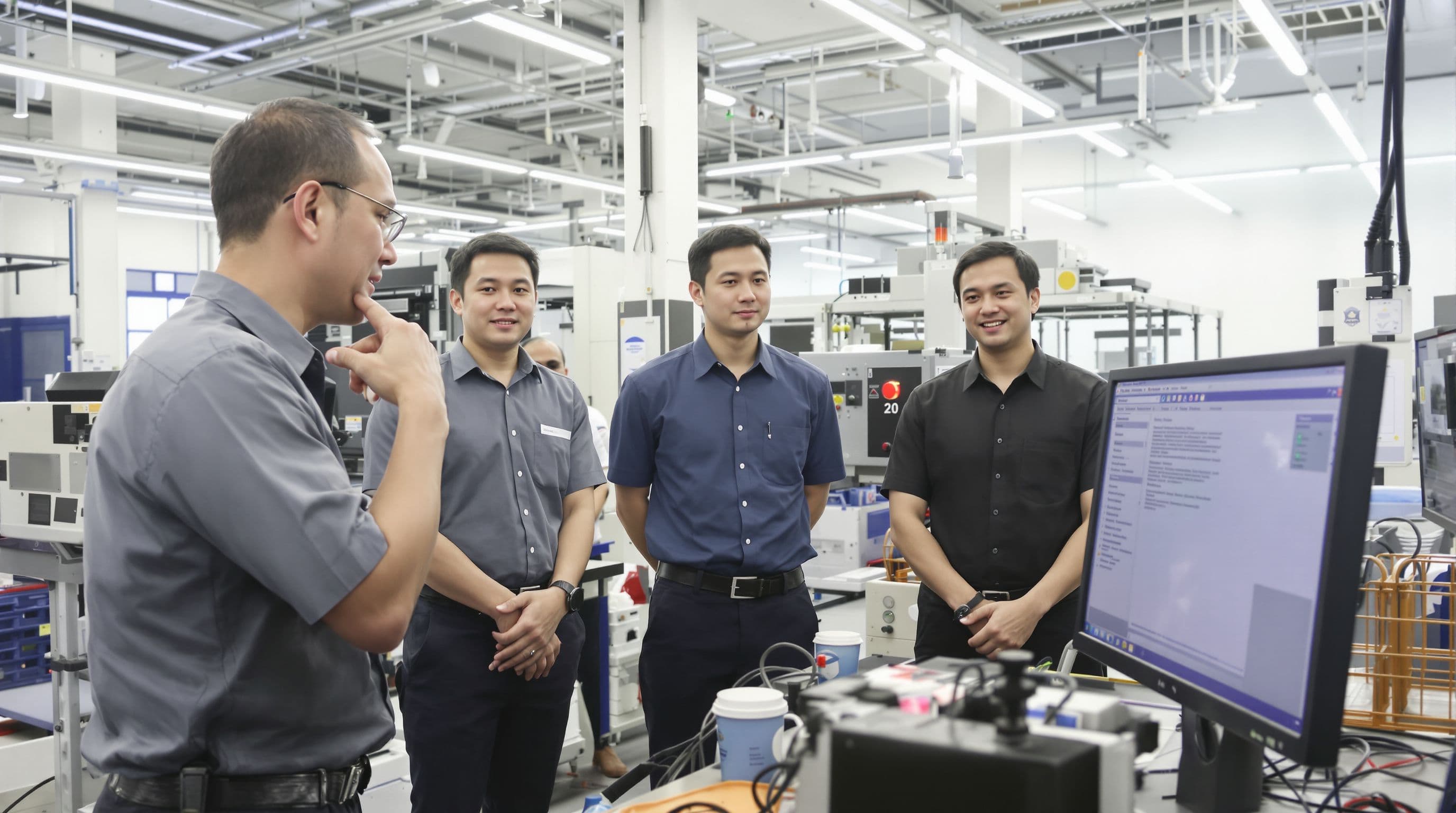
Thai manufacturers can access government-funded AI training through DSD centres, the 200% tax deduction, and special incentives under the Eastern Economic Corridor (EEC) programme. This guide covers Industry 4.0 training pathways, smart factory skills, and how to build AI capabilities in Thailand's manufacturing workforce.
- Thai-registered manufacturing companies (any size)
- Companies operating in EEC zones (additional incentives)
- BOI-promoted manufacturing activities (additional incentives)
- Individual employees must hold valid employment in Thailand
- Training must be registered with DSD for tax deduction
- Companies with 100+ employees subject to Skill Development Promotion Act
- Assess your manufacturing workforce AI skills gaps against Industry 4.0 competency levels
- Register enterprise training plan with DSD via Form SDP 1
- Send employees to DSD ISD centres for foundational Industry 4.0 courses (free)
- Deliver in-house advanced AI training with DSD-registered curriculum
- Submit Form SDP 2 within 60 days of training completion
- For EEC companies: apply for additional training subsidies through EEC office
- Claim 200% tax deduction in annual corporate tax filing
- Measure manufacturing KPI improvements and refine training programme
Industry 4.0 in Thai Manufacturing
Thailand is Southeast Asia's second-largest manufacturing economy, with key sectors including automotive, electronics, food processing, petrochemicals, and textiles. The government's Thailand 4.0 strategy and the Eastern Economic Corridor (EEC) initiative have placed Industry 4.0 transformation at the centre of economic policy. For Thai manufacturers, AI adoption is not just about efficiency — it is about maintaining the country's position as a regional manufacturing hub.
Key AI applications in Thai manufacturing:
- Predictive maintenance: ML models that forecast equipment failures in automotive and electronics factories
- Quality inspection: Computer vision for defect detection in precision manufacturing
- Supply chain optimisation: AI-powered demand forecasting and inventory management
- Process optimisation: Machine learning for production scheduling, yield improvement, and energy management
- Safety monitoring: AI-powered camera systems for workplace safety compliance
- Robotics integration: AI-enhanced industrial robots and cobots for flexible manufacturing
Eastern Economic Corridor (EEC) Digital Workforce Programme
The EEC is Thailand's flagship economic zone encompassing Chachoengsao, Chonburi, and Rayong provinces. The EEC programme includes dedicated workforce development incentives:
EEC Human Capital Development
- EEC Skill Development Centre: A dedicated facility in the eastern provinces offering Industry 4.0 training including AI, IoT, and automation.
- EEC-Industry Partnerships: Major manufacturers (Toyota, Mitsubishi, Samsung) partner with the EEC office to develop shared training curricula.
- EEC Training Subsidies: Companies operating in EEC zones may receive additional training subsidies beyond the standard 200% tax deduction.
- EEC Digital Workforce Fund: Dedicated funding for digital skills training in target industries.
BOI Manufacturing Incentives
The Board of Investment (BOI) offers additional training incentives for promoted manufacturing activities:
- Technology and Innovation Incentive: Companies investing in AI and automation can receive corporate income tax exemptions of up to 8 years, plus additional years based on training investment.
- Training Requirement: BOI-promoted companies must meet minimum training investment thresholds, with AI training counting toward these requirements.
- Skills Development Deduction: BOI-promoted companies can claim training deductions in addition to income tax exemptions.
DSD Programmes for Manufacturing AI
Institute of Skill Development (ISD) Manufacturing Courses
-
IoT and Smart Systems — 80 hours. Sensor deployment, data collection, edge computing, and basic AI inference for manufacturing environments. Available at ISD centres in Chonburi, Samut Prakan, and Nonthaburi.
-
Industrial Automation and Robotics — 120 hours. PLC programming, robot operation, and AI-enhanced automation for production lines. Includes hands-on practice with industrial equipment.
-
Computer-Aided Manufacturing — 90 hours. CAD/CAM with AI-powered design optimisation, CNC programming, and additive manufacturing.
-
Quality Control and Inspection — 60 hours. Statistical process control, measurement techniques, and introduction to AI-powered visual inspection systems.
-
Maintenance Technology — 80 hours. Preventive and predictive maintenance techniques, including sensor-based condition monitoring and basic ML for failure prediction.
Provincial Centre Manufacturing Skills
Provincial skill development centres offer foundational courses:
- Welding and fabrication with digital quality monitoring
- Electrical systems with smart building technology
- Mechanical maintenance with basic sensor integration
Building a Manufacturing AI Training Programme
Skills Assessment Framework
Before designing training, map your workforce against Industry 4.0 competency levels:
Level 1 — Digital Awareness (All manufacturing staff)
- Understanding AI and automation concepts
- Using digital tools for daily tasks
- Data collection and basic reporting
- Target: DSD centre or online training (free)
Level 2 — Digital Application (Operators, technicians, supervisors)
- Operating AI-enhanced equipment and systems
- Monitoring AI system outputs and alerts
- Basic troubleshooting of automated systems
- Target: DSD ISD centre training or in-house with 200% deduction
Level 3 — Digital Integration (Engineers, specialists, managers)
- Implementing AI solutions on production lines
- Configuring and tuning AI models for manufacturing
- Managing AI projects and measuring ROI
- Target: Advanced enterprise training with 200% deduction + depa grants
Level 4 — Digital Innovation (R&D, data scientists, AI engineers)
- Developing custom AI models for manufacturing processes
- Integrating AI with manufacturing execution systems (MES)
- Research and prototyping of new AI applications
- Target: University partnerships + specialised providers
Implementation Roadmap
Phase 1 (Months 1-3): Foundation
- Assess current workforce digital skills
- Register enterprise training plan with DSD (Form SDP 1)
- Send key staff to DSD ISD centres for foundational courses
- Cost: Free (DSD) + minimal admin time
Phase 2 (Months 3-6): Applied Skills
- Deliver in-house AI training focused on your specific processes
- Claim 200% tax deduction for all qualifying training
- Apply for depa grants if eligible
- Cost: Significantly offset by tax deduction
Phase 3 (Months 6-12): Advanced Capabilities
- Partner with Pertama Partners for industry-specific AI implementation training
- Send engineers to university AI programmes
- Begin AI pilot projects with trained staff
- Cost: Offset by tax deduction + productivity gains
Phase 4 (Ongoing): Continuous Development
- Regular refresher training on new AI technologies
- Knowledge sharing across teams and shifts
- TPQI professional qualification assessment for key staff
Combining Government Incentives for Maximum Impact
Thai manufacturers can layer incentives for maximum training value:
| Incentive | Value | Eligibility |
|---|---|---|
| Free DSD training | 100% of course cost | All Thai employees |
| 200% tax deduction | 40% effective cost reduction | All registered companies |
| depa grants | Up to THB 100,000 | Thai SMEs |
| EEC training subsidies | Additional subsidies | EEC zone companies |
| BOI training incentives | Additional deductions | BOI-promoted companies |
For a BOI-promoted manufacturer in an EEC zone, AI training can generate a net positive financial return through combined tax benefits.
Pertama Partners Manufacturing AI Training
Pertama Partners delivers AI training designed for manufacturing environments in Thailand. Our programmes are:
- Registered with DSD for the 200% tax deduction
- Aligned with EEC Digital Workforce standards
- Designed for practical, factory-floor application
- Available in Thai and English
Our Manufacturing AI programmes include:
- Computer vision for quality inspection (hands-on with your production line)
- Predictive maintenance implementation (using your equipment data)
- AI for production planning and scheduling
- Industry 4.0 readiness assessment and roadmap
- AI-powered supply chain optimisation
Contact us to build an AI-capable manufacturing workforce with maximum government support.
Common Questions
Yes. Companies operating in the EEC zones (Chachoengsao, Chonburi, Rayong) can access the EEC Skill Development Centre, dedicated training subsidies, and workforce development partnerships beyond the standard DSD programmes. Combined with BOI incentives for promoted activities, EEC manufacturers have the most comprehensive training support available in Thailand.
Absolutely. DSD courses are designed for practical skills at all levels, including factory operators. Start with digital awareness training (understanding AI concepts and using digital tools), then progress to equipment-specific AI training (operating AI-enhanced machinery, monitoring automated quality systems). DSD ISD centres have hands-on equipment for practical training.
Track key manufacturing metrics before and after training: Overall Equipment Effectiveness (OEE), defect rates, unplanned downtime, energy consumption, and inventory accuracy. Thai manufacturers who have implemented AI after structured training typically see 15-25% improvement in OEE and 20-40% reduction in quality defects within 6-12 months. Factor in the 200% tax deduction to calculate net training ROI.
Very relevant. Thailand is a major food processing hub, and AI applications include quality inspection (visual detection of contamination), demand forecasting for perishable inventory, process optimisation for cooking and packaging lines, cold chain monitoring with IoT sensors, and compliance with FDA Thailand and international food safety standards. DSD offers food industry training that can be complemented with AI-specific modules.
Yes. The 200% tax deduction and DSD training programmes are available to all companies registered in Thailand, regardless of ownership nationality. Many Japanese, European, and American manufacturers in Thailand actively use these incentives. Individual employees must be legally employed in Thailand, but both Thai and foreign workers with valid work permits can participate.
References
- Department of Skill Development - Ministry of Labour. DSD Thailand (2025). View source
- DEPA Digital Skill Roadmap. Digital Economy Promotion Agency (2024). View source
- BOI Thailand. BOI (2025). View source
Explore AI consulting, training, and solutions in Thailand.
View Thailand hubGet NSDA-aligned AI training for your manufacturing team
We help organizations navigate funding programs and deliver claimable AI training. Let us know what you are working on.
Start a Conversation